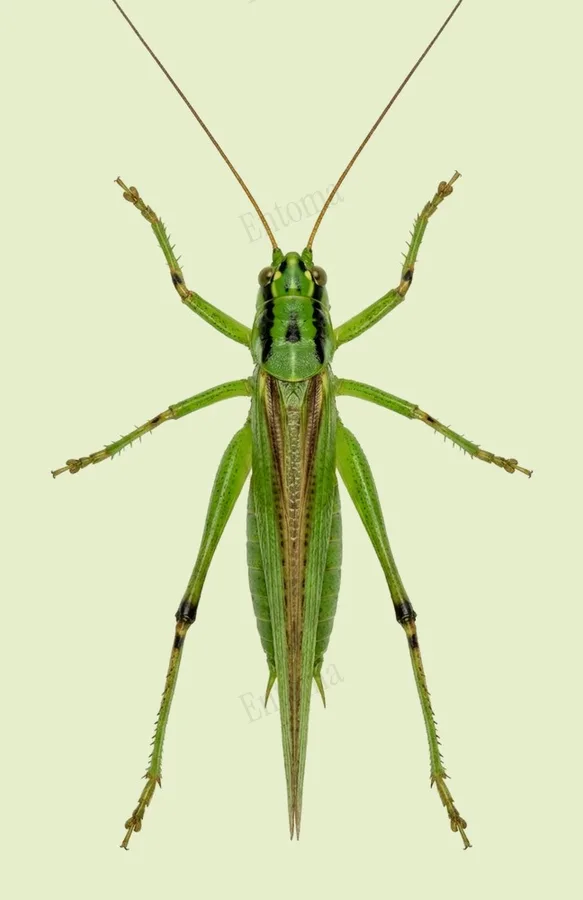
Black-kneed meadow katydid
Newly hatched Black-kneed meadow katydid nymphs are bright crimson orange all over, a striking colour they lose after early moults as the green and black adult pattern develops.
| Where | Grassy meadows, roadsides and silvergrass |
|---|---|
| Size | 22 to 25 mm body length |
| When | April to December |
Adults are green with a black head and thorax, black forewings, and dark bands at the knee joints of the hind legs, the feature that gives the species its common name.
It lives year round in dense grass and silvergrass stands, where females lay eggs into plant stems, and both nymphs and adults can be active by day or after dark.
Traits
Habitat
Grassland
Colour
Green, Black
Active
Day and night
To people
Common in tall grass; does not bite or sting people.
Activity through the year
Often confused with
Has brown wings and lacks black colouring on the hind leg segments, unlike the black forewings and dark kneed hind legs of the Black-kneed meadow katydid.
Questions
Is the Black-kneed meadow katydid dangerous to people?
Common in tall grass; does not bite or sting people.
When can you see the Black-kneed meadow katydid?
The Black-kneed meadow katydid can be seen from April to December, by day and at night.
Plate retouched from a museum specimen photo by Natural History Museum, CC0, GBIF Licence
Report a mistake in this entry
Crickets and grasshoppers›Bush crickets›Conocephalus
Last updated 2026-09-27. Every entry is checked against published sources.