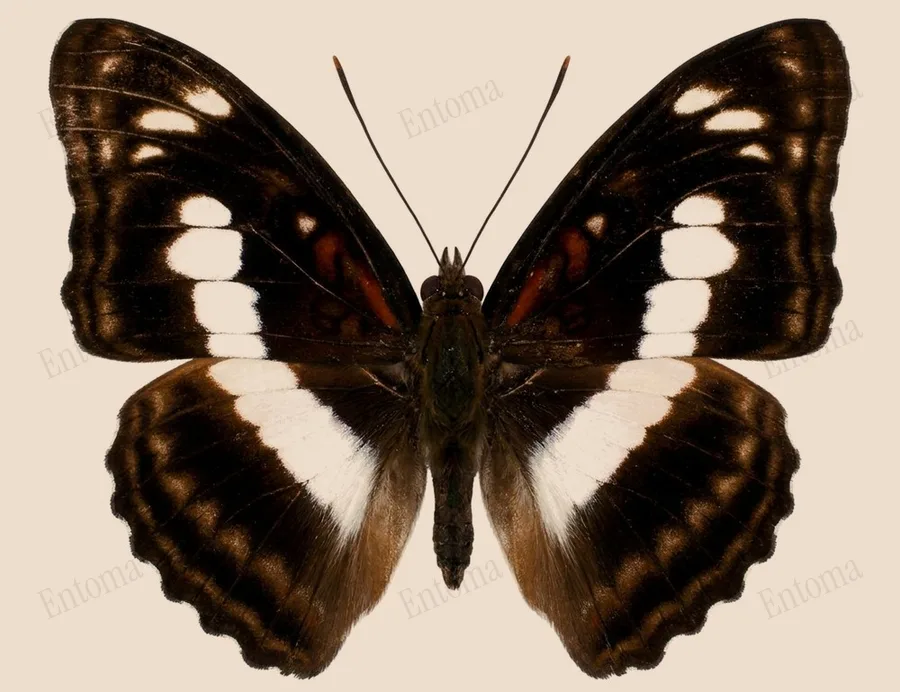
Staff sergeant
Male Staff sergeants show a single broad white band on each forewing, while females carry three separate white bands in the same space.
| Where | Lowland to hill forest |
|---|---|
| Size | 50 to 72 mm wingspan |
| When | January to December |
This nymphalid butterfly is black to blackish brown above, with males showing a single wide white band across each forewing and a plain white band on the hindwing, while females show three narrower white bands instead of one. The underside is chestnut brown with the same white markings repeated more clearly.
Caterpillars feed on shrubs in the coffee family, including wild gardenia and beach gardenia, and the species produces several overlapping generations across the year rather than one distinct flight period. Adults visit flowers and damp ground in lowland and hill forest.
Traits
Habitat
Woodland
Colour
Black, White, Brown
Active
Day
To people
Harmless to people; does not sting or bite.
Activity through the year
Often confused with
Its forewing band is broken into a row of separate elongated spots rather than the Staff sergeant's more solid, continuous white band.
Questions
Is the Staff sergeant dangerous to people?
Harmless to people; does not sting or bite.
When can you see the Staff sergeant?
The Staff sergeant can be seen from January to December, by day.
Plate retouched from a museum specimen photo by Swiss Natural History Collections - SwissNatColl, CC BY 4.0, GBIF Licence
Report a mistake in this entry
Butterflies and moths›Brush-footed butterflies›Athyma
Last updated 2026-09-27. Every entry is checked against published sources.