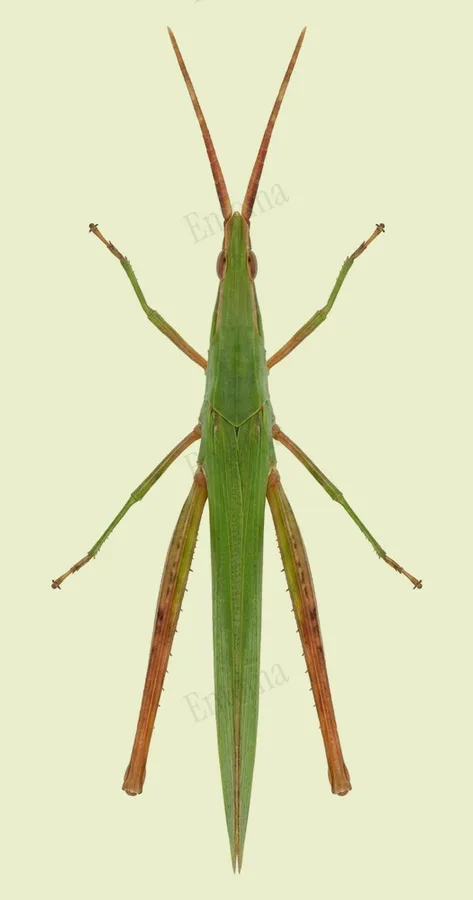
Oriental longheaded locust
Its legs cannot rub together to chirp like most grasshoppers, yet it still makes a soft chi chi chi sound in flight using its wings.
| Where | Tall grass in open fields |
|---|---|
| Size | 40 to 90 mm body length |
| When | May to October |
This grasshopper has an unmistakable long, pointed, triangular head and very long antennae, with a slender body that can be green or brown and hind legs built for powerful jumps.
Females grow much larger than males and both feed on grasses in open, thickly grown fields, relying on their shape and colour to disappear among grass blades.
Traits
Habitat
Grassland
Colour
Green, Brown
Active
Day
To people
Harmless to people; it neither bites nor stings and simply leaps away when disturbed.
Activity through the year
Often confused with
Similar elongated shape and colouring, but with shorter legs and much weaker jumping, escaping mainly by flying off or pressing flat against grass instead of leaping.
Questions
Is the Oriental longheaded locust dangerous to people?
Harmless to people; it neither bites nor stings and simply leaps away when disturbed.
When can you see the Oriental longheaded locust?
The Oriental longheaded locust can be seen from May to October, by day.
Plate retouched from a photo by WATANABE Hitoshi 渡辺仁, CC BY 4.0, iNaturalist Licence
Report a mistake in this entry
Crickets and grasshoppers›Grasshoppers›Acrida
Last updated 2026-09-27. Every entry is checked against published sources.