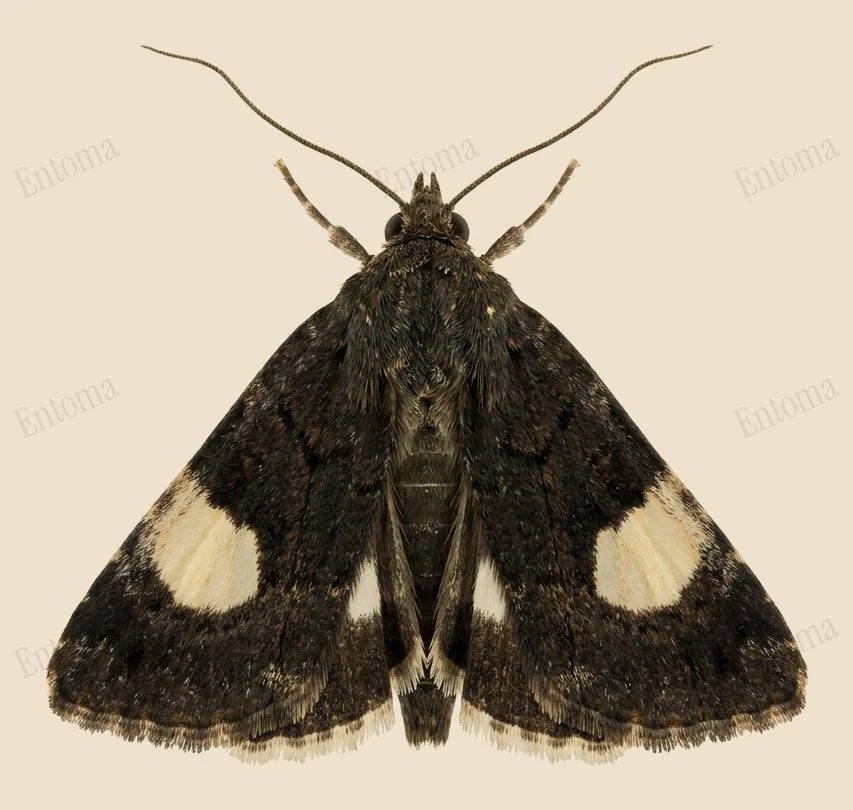
Four-spotted moth
Unlike most of its relatives, this small moth often flies in bright sunshine over dry, open ground, visiting bindweed flowers by day as well as at dusk.
| Where | Dry, sunny grassland and wasteland |
|---|---|
| Size | 20 to 25 mm wingspan |
| When | May to August |
The Four-spotted moth is a small, distinctive species with a wingspan of about 20 to 25 mm, its dark brownish-black forewings marked by a large white patch and a white band crossing the hindwing.
Caterpillars feed exclusively on field bindweed, favouring the flower buds, and the species is restricted to dry, sandy or chalky open ground and wasteland where this foodplant grows in warm, sunny conditions.
Traits
Habitat
Grassland
Colour
Brown, White
Active
Day and night
To people
Sometimes seen flying by day; harmless to people.
Activity through the year
Often confused with
Listed as a similar species but noticeably larger, with a wingspan of 34 to 40 mm compared to the Four-spotted moth's 20 to 25 mm, making size the easiest way to tell them apart.
Questions
Is the Four-spotted moth dangerous to people?
Sometimes seen flying by day; harmless to people.
When can you see the Four-spotted moth?
The Four-spotted moth can be seen from May to August, by day and at night.
Plate retouched from a photo by David Short from Windsor, UK, CC BY 2.0, Wikimedia Commons Licence
Report a mistake in this entry
Butterflies and moths›Erebid moths›Tyta
Last updated 2026-09-26. Every entry is checked against published sources.