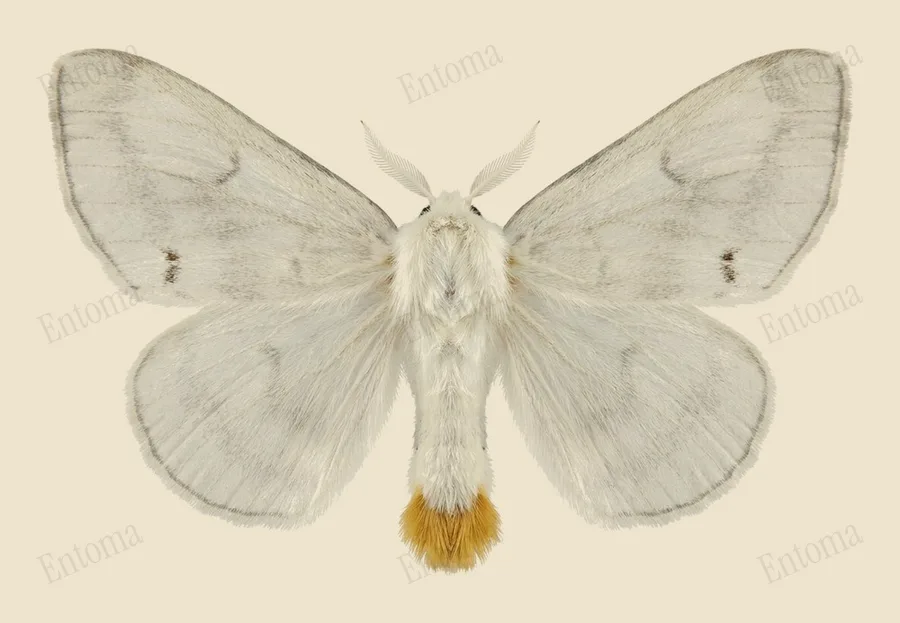
Swan moth
A single hairy caterpillar of this moth can carry hundreds of thousands of tiny detachable spines, and windblown clumps once caused a mass skin outbreak in one city.
| Where | Hedgerows, woodland edges and gardens |
|---|---|
| Size | 35 to 45 mm wingspan |
| When | May to September |
The Swan moth is a silky white moth with a wingspan of about 35 to 45 mm, and females carry a conspicuous tuft of yellow hairs at the tip of the abdomen that is used to cover freshly laid eggs.
Caterpillars are covered in dense tufts of barbed, detachable hairs and feed communally on hawthorn, bramble and other shrubs, overwintering as young larvae inside a shared silken web before resuming feeding in spring.
Traits
Habitat
Garden
Colour
White, Yellow
Active
Night
To people
Take care
Adults are harmless, but the caterpillar's barbed hairs can cause an itchy rash and should not be handled bare-handed.
Activity through the year
Often confused with
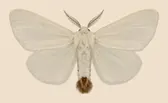
Very similar in size at 36 to 42 mm wingspan and also silky white, but told apart by its brown, not yellow, tail tuft, and its caterpillars carry hairs that are even more strongly irritating.
Questions
Is the Swan moth dangerous to people?
Take care. Adults are harmless, but the caterpillar's barbed hairs can cause an itchy rash and should not be handled bare-handed.
When can you see the Swan moth?
The Swan moth can be seen from May to September, at night.
Plate retouched from a photo by Didier Descouens, CC BY‑SA 4.0, Wikimedia Commons Licence
The plate on this page is shared under the same licence as its source, CC BY-SA.
Report a mistake in this entry
Butterflies and moths›Erebid moths›Sphrageidus
Last updated 2026-09-26. Every entry is checked against published sources.