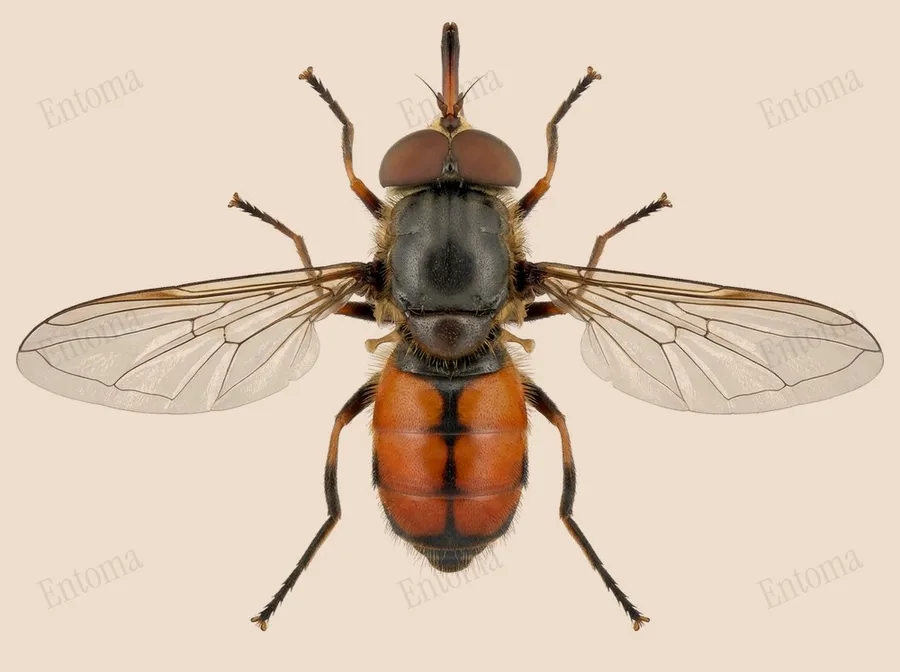
Heineken fly
Its long snout works like a drinking straw, letting it reach nectar deep inside tubular flowers that most other hoverflies cannot use.
| Where | Hedgerows and pasture near grazing cattle |
|---|---|
| Size | 7 to 11 mm body length |
| When | April to September |
This hoverfly is easily told apart by its long, orange brown, forward pointing snout, which is longer than the width of the eye seen from the side. The abdomen is broadly orange with a black line down the middle and black margins along its sides, and the hind tibia carries a dark ring.
Females lay eggs on vegetation overhanging cow dung, and the larvae develop within the dung itself, camouflaged among its particles, producing two generations across the year in pastures where cattle graze.
Traits
Habitat
Farmland
Colour
Orange, Black
Active
Day
To people
Harmless to people; it has no sting, and its long snout is used only to reach nectar deep inside flowers.
Activity through the year
Often confused with
Similar in size at 7 to 10 mm, but with a completely orange abdomen lacking the dark side margins of the Heineken fly, and a paler, grey tinged thorax.
Questions
Is the Heineken fly dangerous to people?
Harmless to people; it has no sting, and its long snout is used only to reach nectar deep inside flowers.
When can you see the Heineken fly?
The Heineken fly can be seen from April to September, by day.
Plate retouched from a photo by S. Rae from Scotland, UK, CC BY 2.0, Wikimedia Commons Licence
Report a mistake in this entry
Last updated 2026-09-26. Every entry is checked against published sources.