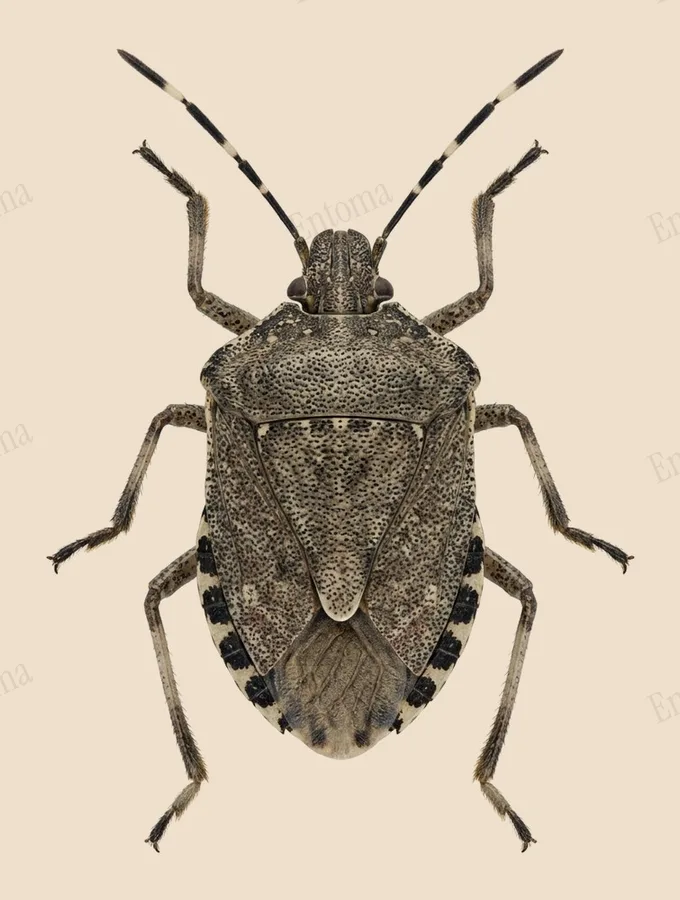
Mottled stink bug
Searching for winter shelter in autumn, it often squeezes into cracks in walls covered with ivy and ends up wandering indoors by accident.
| Where | Broadleaved woodland, hedgerows, orchards |
|---|---|
| Size | 14 to 16 mm long |
| When | February to October |
It is a large, hairless shield bug in dirty yellowish-grey to brown tones, with black-and-yellow banding along the edge of the abdomen and black-and-yellow rings on the middle antennal segments.
It feeds on sap from a wide range of broadleaved trees such as oak, birch and hawthorn, and releases a strong-smelling defensive secretion from glands on the underside of the thorax if disturbed.
Traits
Habitat
Woodland
Colour
Brown, Grey, Yellow
Active
Day
To people
Harmless; releases a strong odour if handled but does not bite or sting
Activity through the year
Often confused with
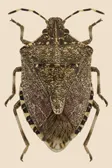
The brown marmorated stink bug has white rings on two adjacent antennal segments meeting directly, while the mottled stink bug's white rings are separated by a dark band.
Questions
Is the Mottled stink bug dangerous to people?
Harmless; releases a strong odour if handled but does not bite or sting.
When can you see the Mottled stink bug?
The Mottled stink bug can be seen from February to October, by day.
Plate retouched from a photo by Rosa-Maria Rinkl, CC BY‑SA 4.0, Wikimedia Commons Licence
The plate on this page is shared under the same licence as its source, CC BY-SA.
Report a mistake in this entry
True bugs›Shield bugs›Rhaphigaster
Last updated 2026-09-26. Every entry is checked against published sources.