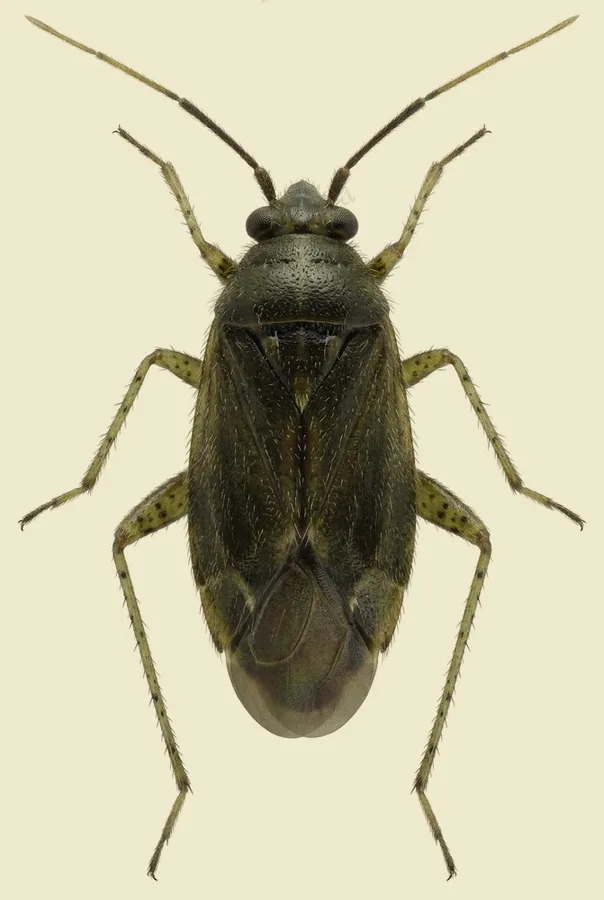
Common nettle flower bug
This tiny mirid bug's colour ranges from pale olive green to almost black, and a single dark line along its hind leg margin persists even in young nymphs.
| Where | Nettle patches, hedgerows and gardens |
|---|---|
| Size | 3.6 to 4.5 mm body length |
| When | June to August |
Adults reach about 3.6 to 4.5 mm long and vary from pale olive green to almost black, with the head, front of the pronotum and first two antennal segments usually dark. A blackish line runs along the edge of the hind femur, a feature that shows even in late nymph stages, and both the wing covers and pronotum are covered in fine dark hairs.
Both adults and nymphs feed by sucking on the buds, flowers and young fruits of a wide range of herbaceous plants, especially stinging nettle and other members of the nettle, daisy, mint, pea and rose families. It is common and widespread across gardens, hedgerows and rough grassland wherever its host plants grow.
Traits
Habitat
Garden
Colour
Green, Black
Active
Day
To people
Feeds only on plant sap and poses no threat to people or pets.
Activity through the year
Often confused with
Slightly smaller at about 3.5 mm long, without the sharply blackened hind femur margin that identifies the Common nettle flower bug, and its legs carry darker markings.
Questions
Is the Common nettle flower bug dangerous to people?
Feeds only on plant sap and poses no threat to people or pets.
When can you see the Common nettle flower bug?
The Common nettle flower bug can be seen from June to August, by day.
Plate retouched from a photo by janet graham, CC BY 2.0, Wikimedia Commons Licence
Report a mistake in this entry
True bugs›Plant bugs›Plagiognathus
Last updated 2026-09-26. Every entry is checked against published sources.