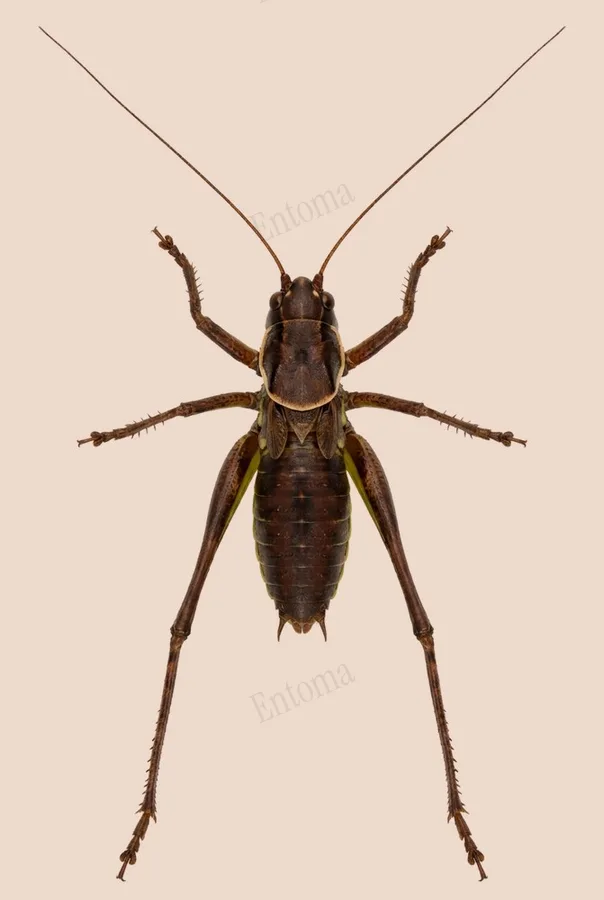
Dark bush-cricket
Although it is a bush-cricket, the male cannot fly at all and sings by rubbing together wing stubs no longer than its collar-like pronotum.
| Where | Hedgerows, scrub, woodland edges, grassland |
|---|---|
| Size | 15 to 17 mm long |
| When | April to October |
It is a dark brown to blackish insect with a paler edge along the sides of the pronotum and a yellowish-green underside. Males carry short brown wing stubs used only for sound, while females are almost wingless and carry a long, upward-curved, sword-like ovipositor.
Females lay eggs in late summer in bark crevices or rotting wood, and these take about eighteen months to hatch, so the population does not overlap neatly with a single yearly generation.
Traits
Habitat
Grassland
Colour
Brown, Black, Yellow
Active
Day and night
To people
Harmless
Activity through the year
Often confused with
Roesel's bush-cricket is browner or greener with a pale-edged pronotum and gives a long, continuous, mechanical buzz rather than the dark bush-cricket's short irregular chirps.
Questions
Is the Dark bush-cricket dangerous to people?
The Dark bush-cricket is harmless to people.
When can you see the Dark bush-cricket?
The Dark bush-cricket can be seen from April to October, by day and at night.
Plate retouched from a photo by Magnefl, CC BY‑SA 3.0, Wikimedia Commons Licence
The plate on this page is shared under the same licence as its source, CC BY-SA.
Report a mistake in this entry
Crickets and grasshoppers›Bush crickets›Pholidoptera
Last updated 2026-09-26. Every entry is checked against published sources.