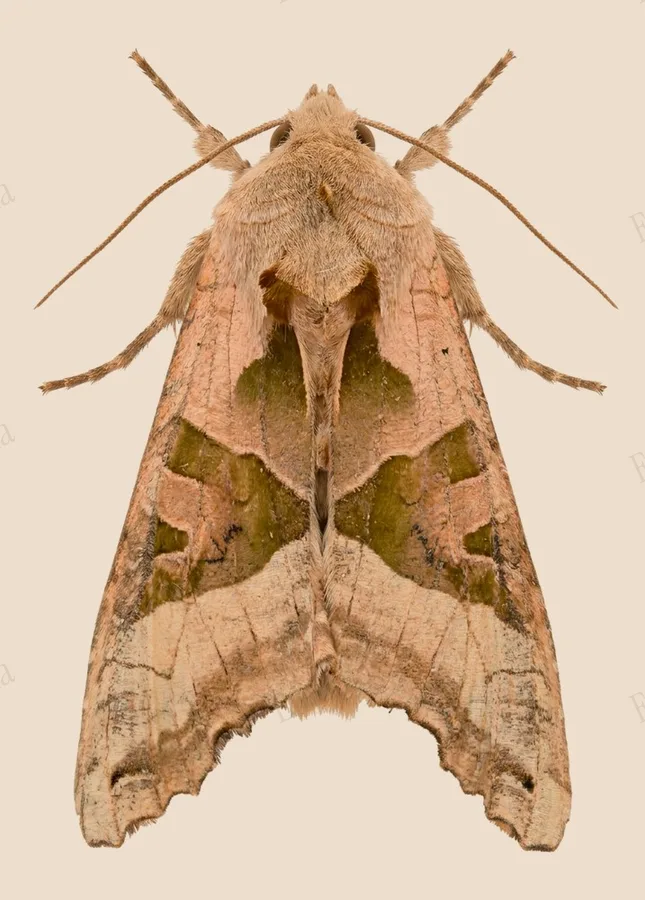
Angle shades
At rest it crumples its wings into ridges and folds so convincingly that it reads as a torn, withered leaf rather than an insect.
| Where | Gardens, hedgerows and fens |
|---|---|
| Size | 45 to 50 mm wingspan |
| When | April to November |
The forewings are pinkish brown with darker olive-green shading and a pattern of angled lines that, combined with the way the wings fold longitudinally at rest, gives the whole moth the look of a curled dead leaf. The wingspan runs from about 45 to 50 mm.
Caterpillars feed on a wide range of low plants and shrubs, including nettle, dock, hop and bramble, and because they can keep feeding through mild winter spells the species is often seen as a larva in almost any month.
Traits
Habitat
Garden
Colour
Brown, Green
Active
Night
To people
Harmless
Activity through the year
Often confused with
The small angle shades has a similar leaf-like resting posture but is much smaller, with a wingspan of only about 27 to 32 mm against the angle shades' 45 to 50 mm.
Questions
Is the Angle shades dangerous to people?
The Angle shades is harmless to people.
When can you see the Angle shades?
The Angle shades can be seen from April to November, at night.
Plate retouched from a photo by No machine-readable author provided. Svdmolen assumed (based on copyright claims, CC BY 2.5, Wikimedia Commons Licence
Report a mistake in this entry
Butterflies and moths›Owlet moths›Phlogophora
Last updated 2026-09-26. Every entry is checked against published sources.