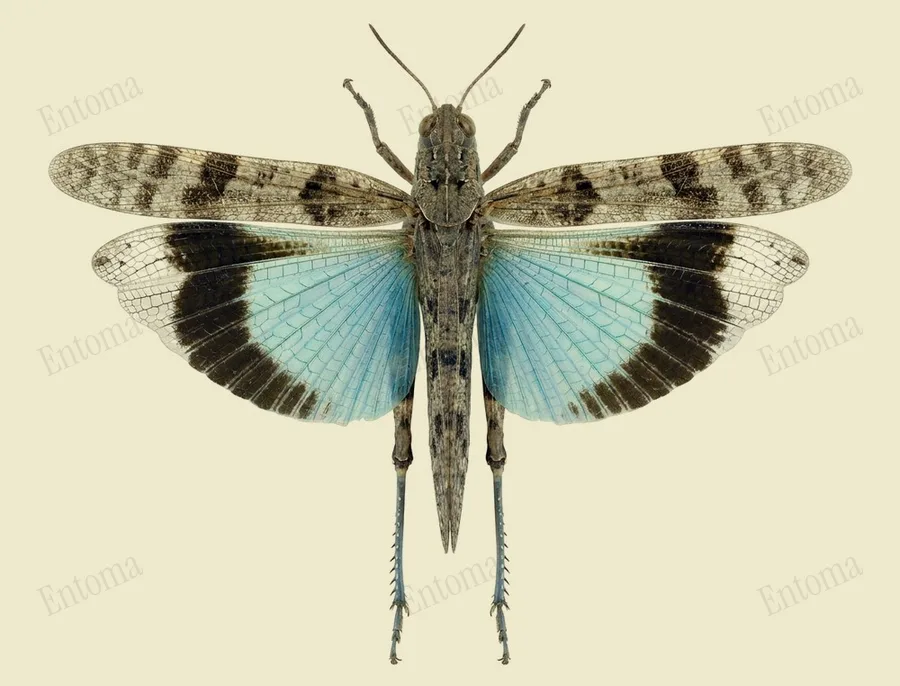
Blue-winged grasshopper
At rest its wings are drab and camouflaged, but in flight this grasshopper flashes bright turquoise-blue hindwings edged in black, a startle display that can confuse pursuing predators.
| Where | Dry, sparsely vegetated ground and quarries |
|---|---|
| Size | 13 to 29 mm body length |
| When | June to October |
The Blue-winged grasshopper is mottled grey or brown at rest, blending closely with bare, stony or sandy ground, and its forewings are crossed by pale bands. A ridge on the upper edge of the hind femur drops sharply behind its midpoint. Only in flight does it reveal turquoise-blue hindwings bordered by a broad dark band, a flash of color that disappears the instant it lands and folds its wings.
Adults fly from June to October over dry, open ground such as heathland, dunes, quarries and railway ballast, where sparse plant cover keeps the soil warm. They feed mainly on grasses and low plants but will also take dead insects, and eggs laid in loose soil overwinter before hatching the following spring.
Traits
Habitat
Heath
Colour
Brown, Grey, Blue
Active
Day
To people
Harmless to people; when disturbed it flies a short distance in a flash of blue and quickly settles again.
Activity through the year
Often confused with
Similar body size, about 15 to 30 mm, but its hindwings are bright red rather than blue, and its pronotum surface is smoother with fewer wrinkles.
Questions
Is the Blue-winged grasshopper dangerous to people?
Harmless to people; when disturbed it flies a short distance in a flash of blue and quickly settles again.
When can you see the Blue-winged grasshopper?
The Blue-winged grasshopper can be seen from June to October, by day.
Plate retouched from a photo by Didier Descouens, CC BY‑SA 4.0, Wikimedia Commons Licence
The plate on this page is shared under the same licence as its source, CC BY-SA.
Report a mistake in this entry
Crickets and grasshoppers›Grasshoppers›Oedipoda
Last updated 2026-09-26. Every entry is checked against published sources.