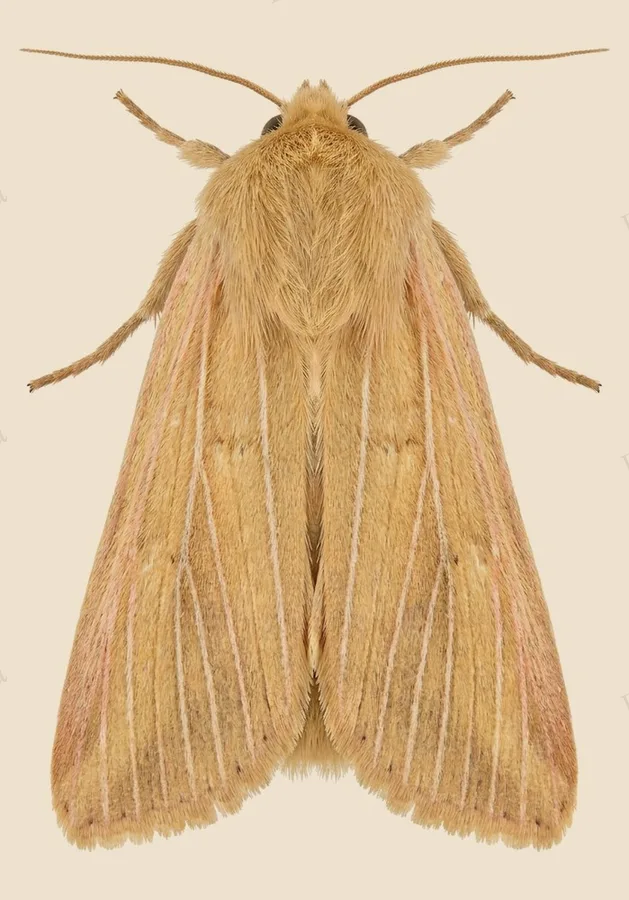
Common wainscot
This unassuming straw colored moth's range stretches from the Atlantic edge of Europe across the continent and Asia to the Kuril Islands near the Pacific coast.
| Where | Grassland, gardens and woodland rides |
|---|---|
| Size | 30 to 35 mm wingspan |
| When | May to October |
The Common Wainscot is a plain straw yellow to pale brown moth with a faint darker streak along each forewing and few other markings, giving it an understated, uniform look.
Two generations fly in southern areas between late spring and autumn, while further north there is usually just one, in high summer. Caterpillars feed on grasses such as cock's foot and annual meadow grass.
Traits
Habitat
Grassland
Colour
Yellow, Brown
Active
Night
To people
Comes to light and sugar bait at night; harmless to people.
Activity through the year
Often confused with
Slightly larger at about 31 to 38 mm wingspan, with darker, smoky brown hindwings compared to the paler, more uniform hindwings of the Common Wainscot.
Questions
Is the Common wainscot dangerous to people?
Comes to light and sugar bait at night; harmless to people.
When can you see the Common wainscot?
The Common wainscot can be seen from May to October, at night.
Plate retouched from a photo by gailhampshire from Cradley, Malvern, U.K, CC BY 2.0, Wikimedia Commons Licence
Report a mistake in this entry
Butterflies and moths›Owlet moths›Mythimna
Last updated 2026-09-26. Every entry is checked against published sources.