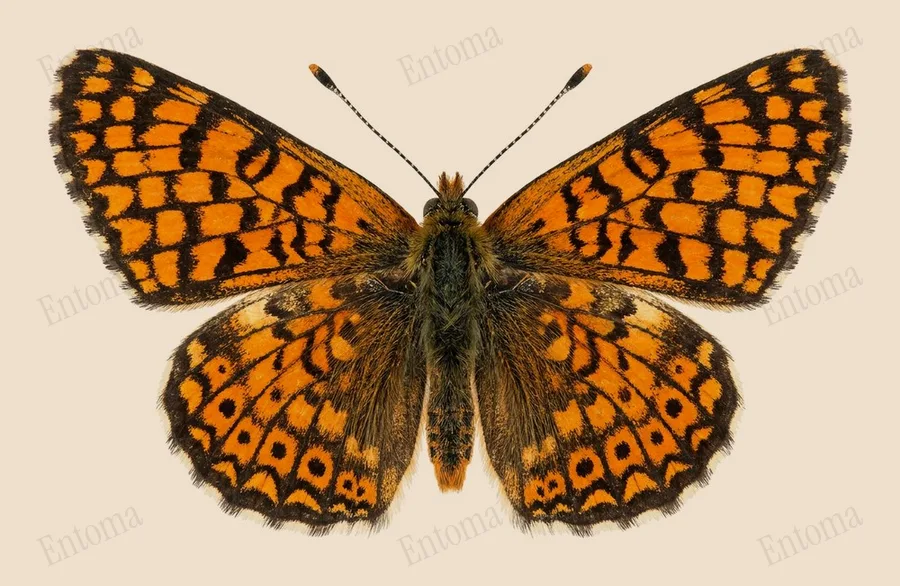
Glanville fritillary
Glanville fritillary caterpillars spend most of their larval life together in a shared silk web, only leaving it alone when the time comes to pupate.
| Where | Coastal cliffs and chalk grassland |
|---|---|
| Size | 41 to 47 mm wingspan |
| When | April to August |
The Glanville fritillary shows an orange and black checkerspot pattern on the upperside, with a neat row of black dots crossing the hindwing that helps separate it from close relatives. The underside is banded in white, orange and black, and the wingspan runs from about 41 to 47 mm.
Caterpillars feed together on ribwort plantain inside a communal silk web, growing side by side until nearly full grown before dispersing to pupate alone. Adults favour open, disturbed ground such as eroding slopes and short grassland, flying in a single main generation.
Traits
Habitat
Coast
Colour
Orange, Black, White
Active
Day
To people
Feeds at flowers on open ground; not known to bite or sting people.
Activity through the year
Often confused with
Similar in pattern and size, the heath fritillary, at 39 to 47 mm, lacks the black spots on the upperside of the hindwing that mark the Glanville fritillary.
Questions
Is the Glanville fritillary dangerous to people?
Feeds at flowers on open ground; not known to bite or sting people.
When can you see the Glanville fritillary?
The Glanville fritillary can be seen from April to August, by day.
Plate retouched from a photo by xulescu_g, CC BY‑SA 2.0, Wikimedia Commons Licence
The plate on this page is shared under the same licence as its source, CC BY-SA.
Report a mistake in this entry
Butterflies and moths›Brush-footed butterflies›Melitaea
Last updated 2026-09-26. Every entry is checked against published sources.