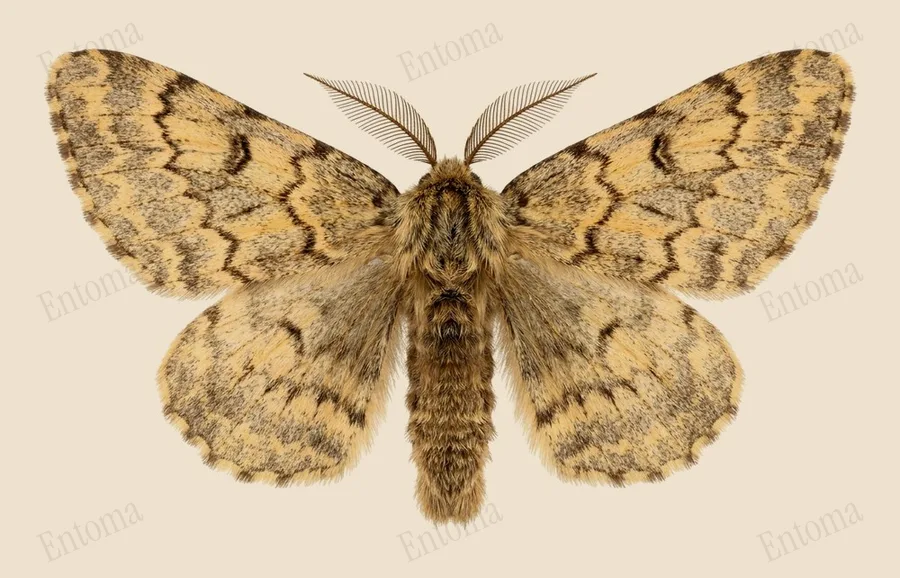
Brindled beauty
Unlike several related geometrid moths that fly in late winter with wingless females, both sexes of the Brindled beauty are fully winged.
| Where | Woodland, hedgerows, parks and gardens |
|---|---|
| Size | 35 to 52 mm wingspan |
| When | March to May |
The Brindled beauty is a large, furry bodied moth with smoky grey forewings crossed by broad black lines that break up its outline against tree bark; females carry a pale yellowish suffusion across the wings.
Caterpillars feed on a wide range of broadleaved trees and shrubs including birch, hawthorn, alder, willow, oak and lime, pupating in the soil over winter, and adults fly from March to May in woodland, hedgerows, parks and gardens.
Traits
Habitat
Woodland
Colour
Grey, Black
Active
Night
To people
Attracted to light; harmless to people.
Activity through the year
Often confused with
Smaller at about 35 to 40 mm wingspan and paler grey, lacking the thick black cross lines of the Brindled beauty, and with a wingless rather than fully winged female.
Questions
Is the Brindled beauty dangerous to people?
Attracted to light; harmless to people.
When can you see the Brindled beauty?
The Brindled beauty can be seen from March to May, at night.
Plate retouched from a photo by Vítězslav Maňák (SLU), CC BY‑SA 3.0, Wikimedia Commons Licence
The plate on this page is shared under the same licence as its source, CC BY-SA.
Report a mistake in this entry
Butterflies and moths›Geometer moths›Lycia
Last updated 2026-09-26. Every entry is checked against published sources.