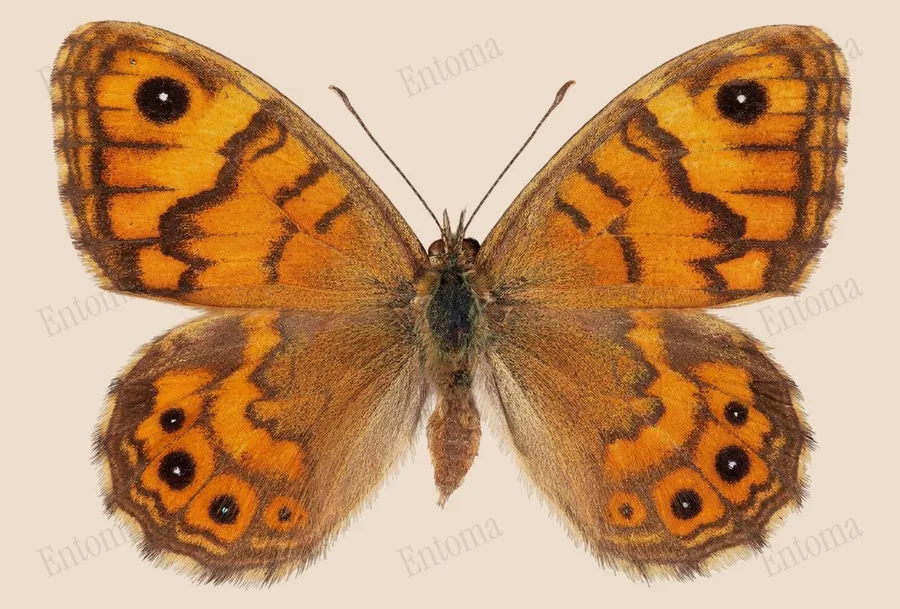
Wall brown
It is named for its habit of basking directly on bare walls, stones and paths to soak up heat, rather than perching on leaves.
| Where | Open grassland and bare ground |
|---|---|
| Size | 42 to 53 mm wingspan |
| When | April to October |
The wings are orange-brown with dark brown markings, one large forewing eyespot with a white center, and up to four smaller eyespots on the hindwing, spanning 42 to 53 mm.
It flies fast and low over open ground, then settles with wings closed against bare rock or soil, using its mottled underside to blend in.
Traits
Habitat
Grassland
Colour
Orange, Brown
Active
Day
To people
Harmless
Activity through the year
Often confused with
The large wall brown is bigger overall, lacks the orange band along the hindwing edge, and shows a continuous rather than broken dark line across the wing.
Questions
Is the Wall brown dangerous to people?
The Wall brown is harmless to people.
When can you see the Wall brown?
The Wall brown can be seen from April to October, by day.
Plate retouched from a photo by Didier Descouens, CC BY‑SA 4.0, Wikimedia Commons Licence
The plate on this page is shared under the same licence as its source, CC BY-SA.
Report a mistake in this entry
Butterflies and moths›Brush-footed butterflies›Lasiommata
Last updated 2026-09-26. Every entry is checked against published sources.