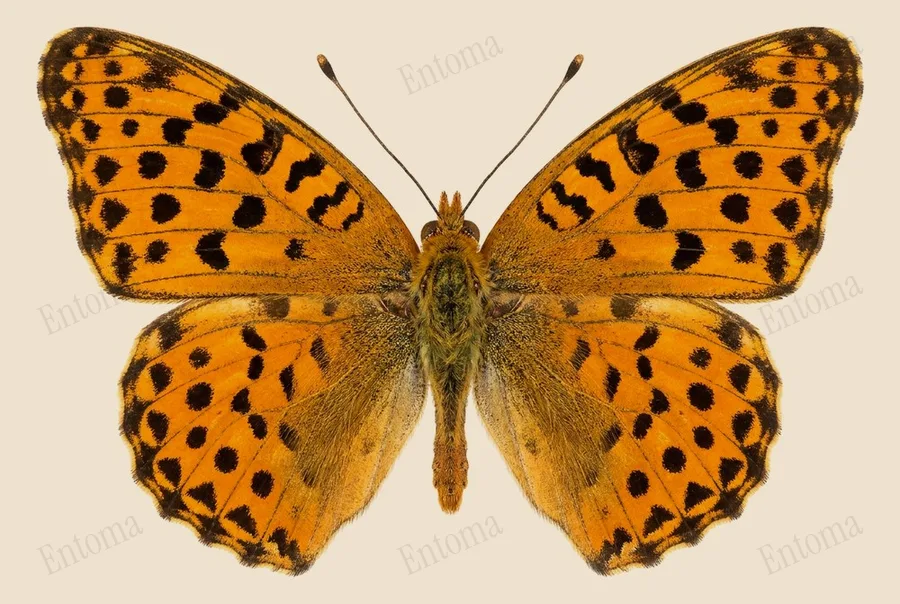
Queen of Spain fritillary
Its hindwing undersides carry large silvery-pearl spots so bright they look metallic, unlike any other European fritillary.
| Where | Dry meadows, heaths, and arable edges |
|---|---|
| Size | 38 to 46 mm wingspan |
| When | April to October |
The upperwings are orange with rows of small black spots, but the underside of the hindwing is the giveaway: it is patterned with big, mirror-bright pearly patches unlike the smaller, duller marks of other fritillaries.
It is a strong disperser and can produce up to three broods in a season, with numbers building through repeated waves of colonisation rather than staying settled in one place.
Traits
Habitat
Grassland
Colour
Orange, Black, White
Active
Day
To people
Harmless to handle
Activity through the year
Often confused with
Boloria selene has a row of small silver spots around the hindwing margin rather than the large solid pearly blotches that cover the Queen of Spain fritillary's underside.
Questions
Is the Queen of Spain fritillary dangerous to people?
Harmless to handle.
When can you see the Queen of Spain fritillary?
The Queen of Spain fritillary can be seen from April to October, by day.
Plate retouched from a photo by Didier Descouens, CC BY‑SA 4.0, Wikimedia Commons Licence
The plate on this page is shared under the same licence as its source, CC BY-SA.
Report a mistake in this entry
Butterflies and moths›Brush-footed butterflies›Issoria
Last updated 2026-09-26. Every entry is checked against published sources.