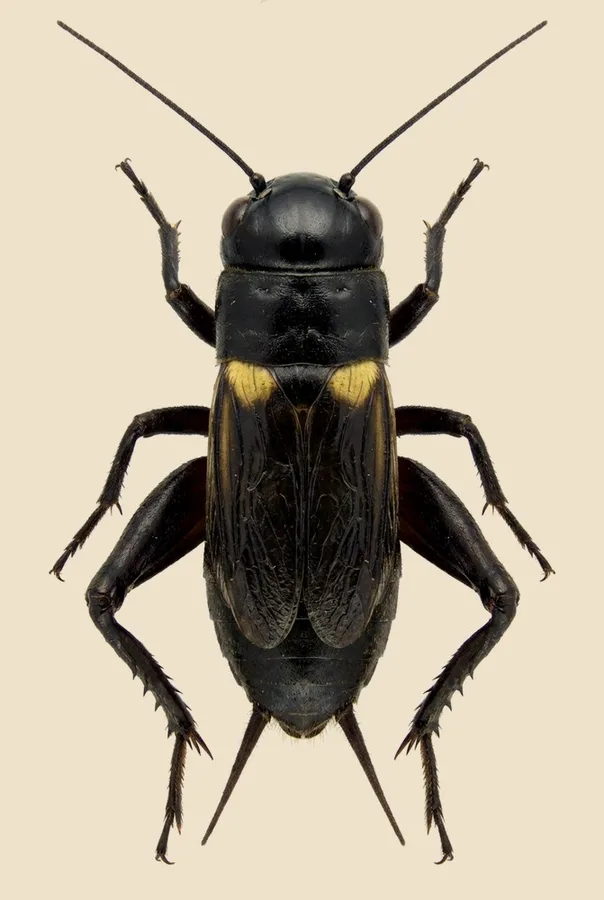
European field cricket
Each male digs and defends his own burrow, singing from a platform at its mouth and diving inside at the first sign of danger.
| Where | Sunny grassland with bare ground |
|---|---|
| Size | 17 to 23 mm long |
| When | April to September |
The European field cricket is a heavy bodied, shiny black cricket with a large rounded head, a pale yellow patch at the base of each forewing, and red brown undersides to the hind thighs. Its hind wings are reduced, so it rarely flies.
Each adult digs and defends its own burrow in short, sun warmed turf, basking at the entrance by day and retreating inside at any disturbance. Nymphs take up to two years to mature before adults appear the following spring.
Traits
Habitat
Grassland
Colour
Black, Yellow, Red
Active
Day
To people
Harmless; it does not bite or sting people.
Activity through the year
Often confused with
The Mediterranean field cricket is noticeably larger, around 30 mm, and shows a pair of pale spots at the base of the forewings that the European field cricket lacks.
Questions
Is the European field cricket dangerous to people?
Harmless; it does not bite or sting people.
When can you see the European field cricket?
The European field cricket can be seen from April to September, by day.
Plate retouched from a photo by Franziska Walz, CC BY‑SA 3.0, Wikimedia Commons Licence
The plate on this page is shared under the same licence as its source, CC BY-SA.
Report a mistake in this entry
Crickets and grasshoppers›True crickets›Gryllus
Last updated 2026-09-26. Every entry is checked against published sources.