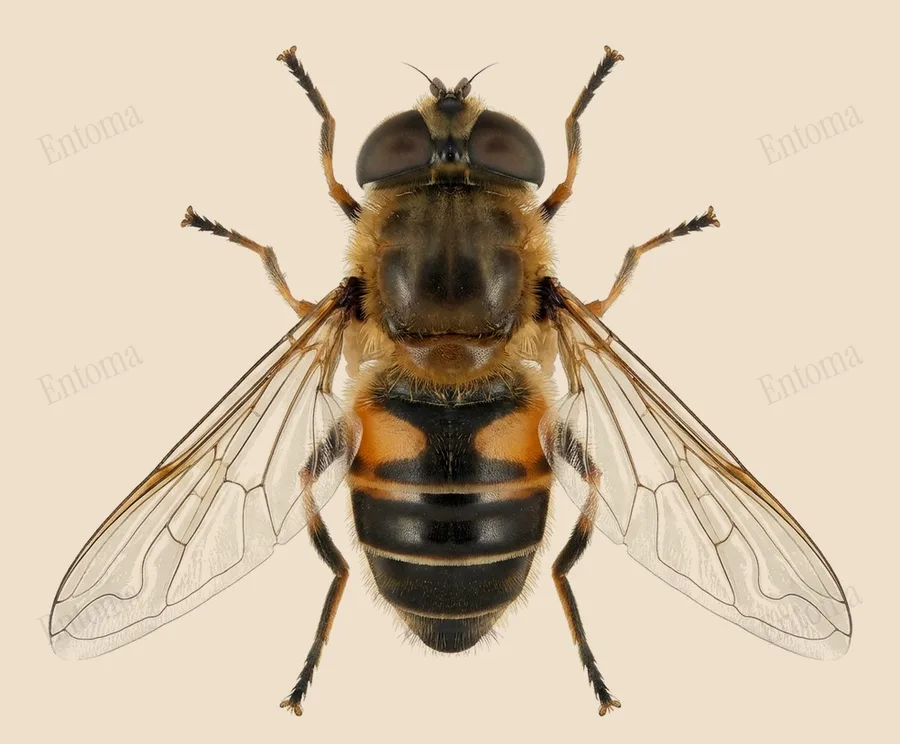
Glass-winged dronefly
This dronefly's wings stay perfectly clear, never smudged with the brown patches common in its closest relatives, which is how it earned its common name.
| Where | Mature deciduous and evergreen forest |
|---|---|
| Size | 13 to 16 mm body length |
| When | March to August |
The Glass-winged dronefly is a large, honeybee-like hoverfly with dark front and mid tarsi and a face heavily dusted with pale powder; unlike related droneflies, its wings stay completely clear rather than smudged with brown.
Long associated with mature deciduous and Mediterranean evergreen forest in southern Europe, the species has been spreading north in recent decades and now turns up as a spring and summer visitor to woodland further north.
Traits
Habitat
Woodland
Colour
Brown, Black
Active
Day
To people
Cannot sting or bite; like other droneflies it only resembles a honeybee for protection from predators.
Activity through the year
Often confused with
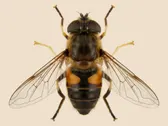
Similar in size but with entirely orange front and mid tarsi rather than black feet, and a more pointed, tapering abdomen in males.
Questions
Is the Glass-winged dronefly dangerous to people?
Cannot sting or bite; like other droneflies it only resembles a honeybee for protection from predators.
When can you see the Glass-winged dronefly?
The Glass-winged dronefly can be seen from March to August, by day.
Plate retouched from a photo by Johannes Sander, CC BY‑SA 4.0, Wikimedia Commons Licence
The plate on this page is shared under the same licence as its source, CC BY-SA.
Report a mistake in this entry
Last updated 2026-09-26. Every entry is checked against published sources.