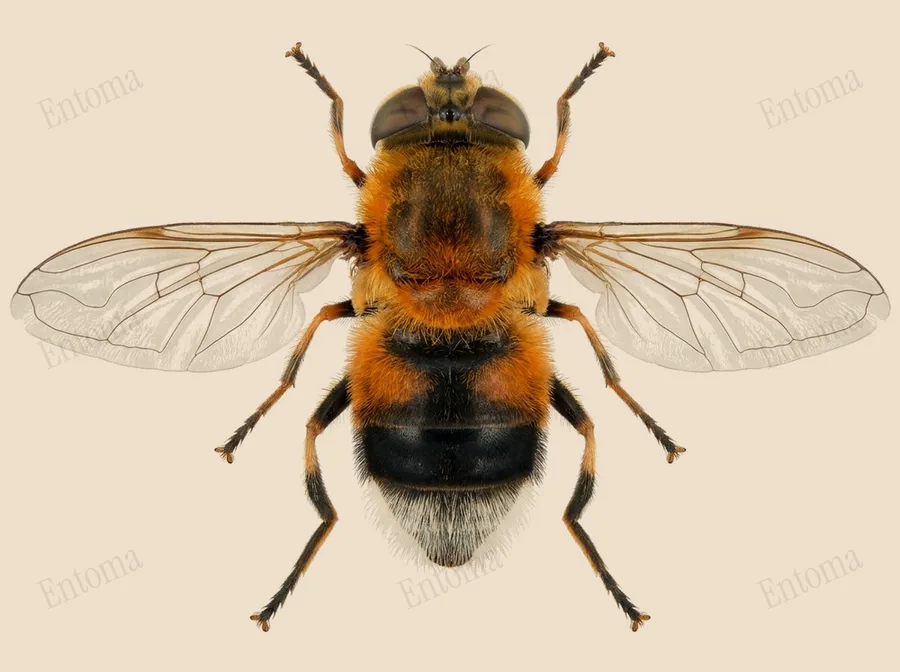
Furry dronefly
Its dense fur and colored tail mimic a bumblebee so closely that males and females are often mistaken for two different species.
| Where | Marshy woodland and wet meadows |
|---|---|
| Size | 11 to 14 mm body length |
| When | April to September |
This is a very furry, bumblebee-mimicking hoverfly with an orange yellow scutellum and dark hind legs with pale tibiae. Males have brownish body hair ending in a reddish brown tail, while females are somewhat larger with blackish hair and a white tipped tail.
Rat-tailed larvae develop in mud, farmyard drains and ponds rich in decaying vegetation, breathing through an extendable tube while adults visit flowers such as willow catkins in wet, marshy woodland.
Traits
Habitat
Wetland
Colour
Orange, Black, Brown
Active
Day
To people
Harmless mimic of a bumblebee; it has no sting and cannot bite, relying on its furry appearance to deter would-be predators.
Activity through the year
Often confused with
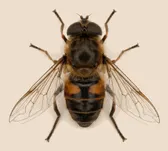
Larger at 14 to 16 mm with a shinier, less densely furred body, a pair of dark vertical bands across the eyes, and a distinctly curved and thickened hind tibia.
Questions
Is the Furry dronefly dangerous to people?
Harmless mimic of a bumblebee; it has no sting and cannot bite, relying on its furry appearance to deter would-be predators.
When can you see the Furry dronefly?
The Furry dronefly can be seen from April to September, by day.
Plate retouched from a photo by kitbeard, CC BY 4.0, Wikimedia Commons Licence
Report a mistake in this entry
Last updated 2026-09-26. Every entry is checked against published sources.