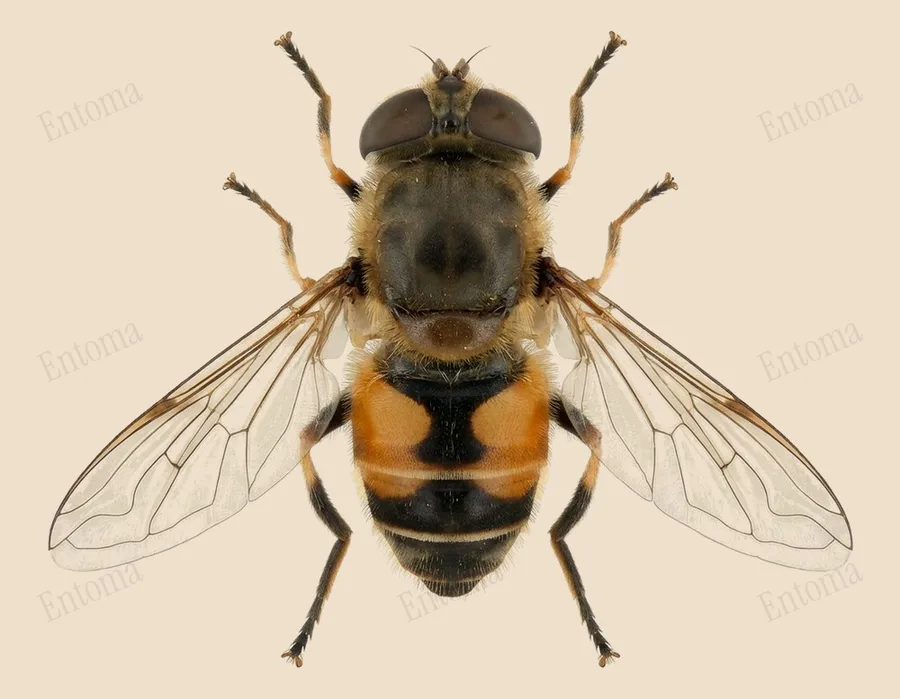
Eurasian drone fly
Despite looking like a small honeybee, this fly's maggot like larvae breathe through a long telescopic tube and live in shallow, nutrient rich water such as manure pools.
| Where | Gardens, wetlands and open urban ground |
|---|---|
| Size | 9 to 11 mm body length |
| When | April to October |
This stocky fly has a completely pale dusted face, without the dark central stripe seen in some related drone flies, and its body markings range from banded to almost entirely black. Its hovering flight and buzzing sound mimic a small honeybee, though it has only one pair of wings.
Larvae are aquatic filter feeders known as rat tailed maggots, breathing through a long extendable tube while living in shallow, oxygen poor water such as manure pools, silage seepage or compost heaps. Adults instead visit flowers for nectar and pollen in gardens and open ground.
Traits
Habitat
Garden
Colour
Black, Brown
Active
Day
To people
Visits garden flowers for nectar and does not bite or sting people.
Activity through the year
Often confused with
Larger at about 15 mm in body length, with dark marbled eyes rather than the plain pale dusted face of the Eurasian drone fly.
Questions
Is the Eurasian drone fly dangerous to people?
Visits garden flowers for nectar and does not bite or sting people.
When can you see the Eurasian drone fly?
The Eurasian drone fly can be seen from April to October, by day.
Plate retouched from a museum specimen photo by Olga Borodina, University of Tartu, Natural History Museum and Botanical Garden, CC BY 4.0, GBIF Licence
Report a mistake in this entry
Last updated 2026-09-26. Every entry is checked against published sources.