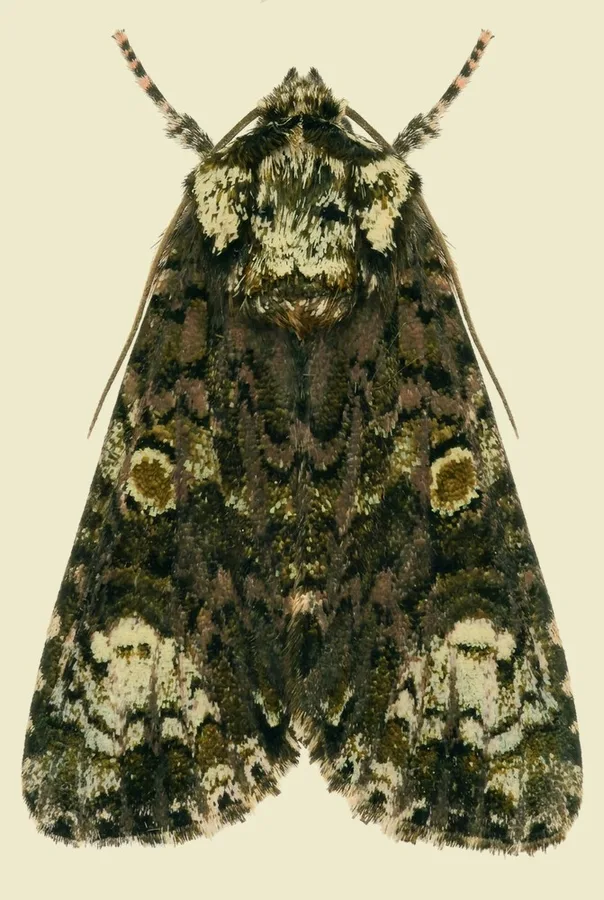
Coronet
This moth's caterpillar feeds openly on ash leaves through late summer, then drops to the soil to pupate and stays hidden underground until the following spring.
| Where | Woodland, hedgerows and wooded gardens |
|---|---|
| Size | 35 to 43 mm wingspan |
| When | May to August |
The Coronet has dark greyish brown forewings marked with a black zigzag line near the base and a scatter of pale marks near the wingtip that break up its outline against bark. It rests by day on tree trunks and fence posts, where the mottled pattern makes it hard to see.
Caterpillars feed at night on ash and wild privet from August into September, then drop to the ground to pupate and pass the winter underground. Adults fly in a single generation from May to August in woodland across much of western and central Europe.
Traits
Habitat
Woodland
Colour
Grey, Brown, White
Active
Night
To people
Rests on tree trunks by day; harmless to people.
Activity through the year
Often confused with
Slightly larger at about 40 to 44 mm wingspan, with a rounder white orbicular mark and a more pointed forewing tip than the Coronet.
Questions
Is the Coronet dangerous to people?
Rests on tree trunks by day; harmless to people.
When can you see the Coronet?
The Coronet can be seen from May to August, at night.
Plate retouched from a photo by janet graham, CC BY 2.0, Wikimedia Commons Licence
Report a mistake in this entry
Butterflies and moths›Owlet moths›Craniophora
Last updated 2026-09-26. Every entry is checked against published sources.