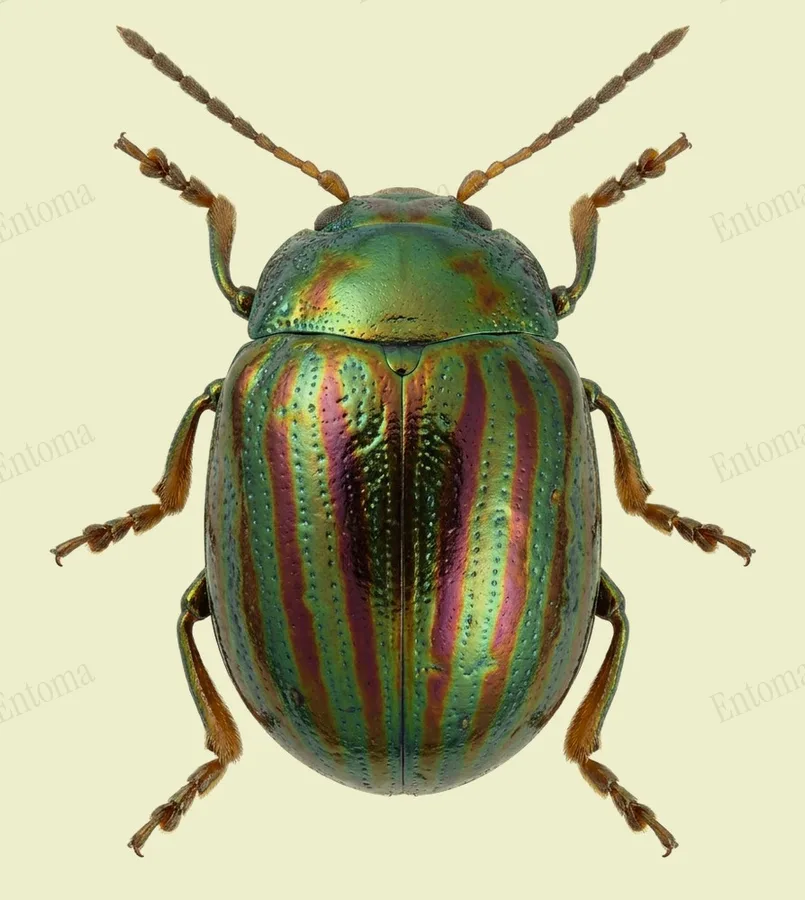
Rosemary beetle
Its scientific name means American, yet the rosemary beetle has never been native to the Americas, being native instead to southern Europe and the Mediterranean.
| Where | Gardens with rosemary and lavender |
|---|---|
| Size | 5 to 8 mm long |
| When | March to October |
It is unmistakable up close: the wing cases carry bold, glossy stripes of metallic green alternating with purple or bronze, on a body about the size of a small ladybird.
Adults and larvae both feed on rosemary, lavender and other aromatic Lamiaceae, and can strip a plant's new growth when numbers build up.
Females lay eggs in late summer, and the banded larvae keep developing through the winter. The beetle usually does little harm to healthy plants. Where it is a nuisance, the beetles can be picked off by hand or shaken onto a sheet of paper.
Traits
Habitat
Garden
Colour
Metallic, Green
Active
Day
To people
Harmless to people; can damage rosemary and lavender plants
Activity through the year
Often confused with
The mint leaf beetle is a slightly larger, more uniformly metallic green or gold-purple beetle, without the rosemary beetle's bold alternating green and purple stripes.
Questions
Is the Rosemary beetle dangerous to people?
Harmless to people; can damage rosemary and lavender plants.
When can you see the Rosemary beetle?
The Rosemary beetle can be seen from March to October, by day.
Sources en.wikipedia.orgrhs.org.ukcoleoptera.org.uk
Plate retouched from a photo by Lamiot, CC BY‑SA 4.0, Wikimedia Commons Licence
The plate on this page is shared under the same licence as its source, CC BY-SA.
Report a mistake in this entry
Beetles›Leaf beetles›Chrysolina
Last updated 2026-10-17. Every entry is checked against published sources.