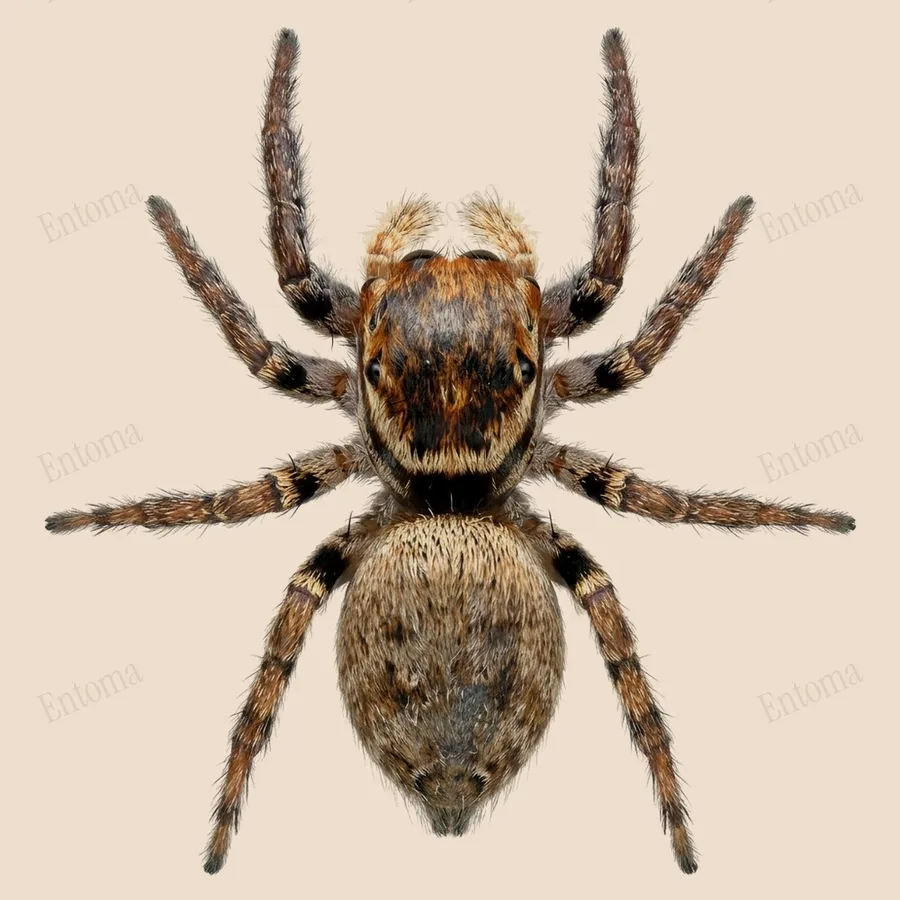
Carrhotus xanthogramma
Males have a glossy black body topped by a flattened, hairy reddish orange abdomen, a striking combination among the jumping spiders of warm shrubland.
| Where | Sunny shrubs and tree trunks, Europe |
|---|---|
| Size | Female 7.1 to 9 mm, male 5.1 to 7.1 mm body length |
| When | March to June and August to October |
This robust jumping spider shows strong differences between the sexes. Males are shiny black with a flattened, hair covered abdomen in reddish orange, while females are mostly brown with a paler front and dark markings forming an arch across the body.
It hunts by day on sun warmed tree trunks and shrubs, relying on sharp eyesight to spot and stalk insects rather than building a web to catch them.
Traits
Habitat
Woodland
Colour
Black, Orange, Brown
Active
Day
To people
A robust jumping spider with no documented bite to people; it relies on its excellent eyesight to hunt rather than defend itself against anything as large as a hand.
Activity through the year
Often confused with
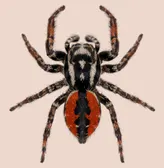
Also a warmth loving, shrub dwelling jumping spider, but the male Golden-eyed jumping spider has a bright orange red abdomen with a black central stripe, unlike the duller, flattened, hairy reddish orange abdomen of male Carrhotus xanthogramma.
Questions
Is Carrhotus xanthogramma dangerous to people?
A robust jumping spider with no documented bite to people; it relies on its excellent eyesight to hunt rather than defend itself against anything as large as a hand.
When can you see Carrhotus xanthogramma?
Carrhotus xanthogramma can be seen from March to June and August to October, by day.
Plate retouched from a photo by Wang.QG, CC BY 4.0, iNaturalist Licence
Report a mistake in this entry
Spiders›Jumping spiders›Carrhotus
Last updated 2026-09-27. Every entry is checked against published sources.