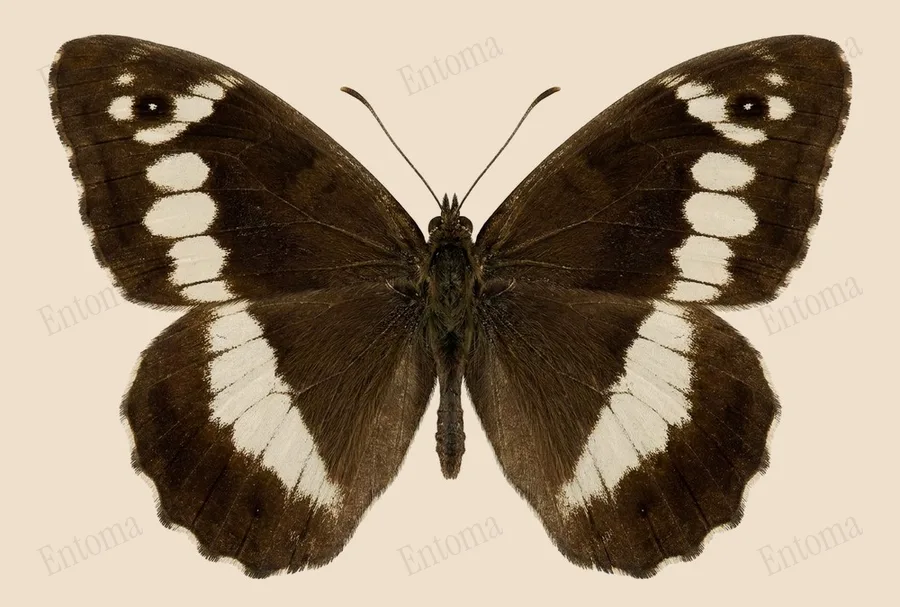
Great banded grayling
This grayling often rests head down on tree trunks with wings closed, using its bark like pattern to vanish against the bark until it is almost touched.
| Where | Dry woodland edges and grassy slopes |
|---|---|
| Size | 65 to 80 mm wingspan |
| When | June to September |
The Great Banded Grayling is a large, dark brown butterfly with a broad white band crossing all four wings near the base and, on the hindwing, a second pale streak further out. The underside carries black eyespots outlined in white, and the wings stay folded shut whenever the butterfly perches.
Adults fly in a single generation from June to September, favouring warm, dry woodland edges and grassy slopes. They spend long periods motionless on tree bark or rocks, relying on camouflage rather than flight to avoid predators, and take off abruptly only when closely approached.
Traits
Habitat
Woodland
Colour
Black, White, Brown
Active
Day
To people
Rests in plain sight on bark or stone; harmless to people.
Activity through the year
Often confused with
Similar in size at about 66 to 76 mm wingspan, but the second white streak on the hindwing is always absent and the eyespots are ringed yellow rather than white.
Questions
Is the Great banded grayling dangerous to people?
Rests in plain sight on bark or stone; harmless to people.
When can you see the Great banded grayling?
The Great banded grayling can be seen from June to September, by day.
Plate retouched from a photo by Didier Descouens, CC BY‑SA 4.0, Wikimedia Commons Licence
The plate on this page is shared under the same licence as its source, CC BY-SA.
Report a mistake in this entry
Butterflies and moths›Brush-footed butterflies›Brintesia
Last updated 2026-09-26. Every entry is checked against published sources.