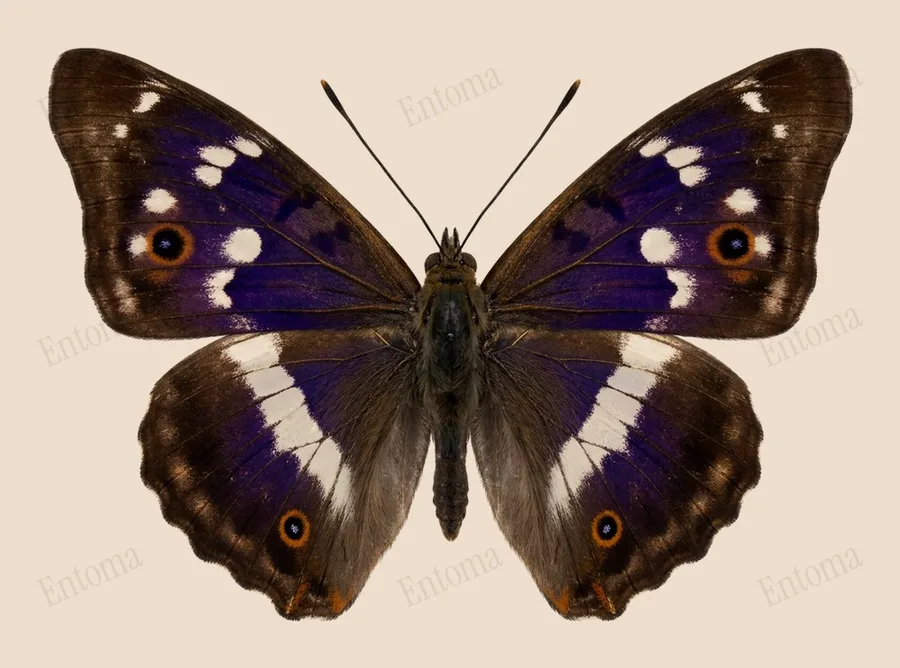
Lesser purple emperor
Males of this iridescent butterfly rarely visit flowers, instead gathering minerals from damp mud, dung, carrion and even sweat, sometimes landing directly on people.
| Where | Broad-leaved woodland with willows and poplars |
|---|---|
| Size | 55 to 70 mm wingspan |
| When | May to September |
The lesser purple emperor is a large butterfly with dark brown to black wings that flash blue-violet in males when caught by the light, crossed by a band of white spots and orange-ringed eyespots on the hindwing. Females are larger and lack the blue sheen.
Adults spend hot weather high in the tree canopy, and males rarely visit flowers, instead gathering minerals from mud, dung, carrion and sweat. Caterpillars feed mainly on poplars, especially aspen and black poplar, with willows taken only occasionally, and overwinter half grown on the bark near a bud.
Traits
Habitat
Woodland
Colour
Black, Blue, Orange
Active
Day
To people
Males sometimes land on people to feed on sweat; harmless to handle.
Activity through the year
Often confused with
Larger at about 70 to 92 mm wingspan; both species show an orange-ringed eyespot on the hindwing, but only the lesser purple emperor also carries one on the forewing, and its white hindwing band lacks the purple emperor's sharp tooth-like projection.
Questions
Is the Lesser purple emperor dangerous to people?
Males sometimes land on people to feed on sweat; harmless to handle.
When can you see the Lesser purple emperor?
The Lesser purple emperor can be seen from May to September, by day.
Plate retouched from a photo by Didier Descouens, CC BY‑SA 4.0, Wikimedia Commons Licence
The plate on this page is shared under the same licence as its source, CC BY-SA.
Report a mistake in this entry
Butterflies and moths›Brush-footed butterflies›Apatura
Last updated 2026-09-26. Every entry is checked against published sources.