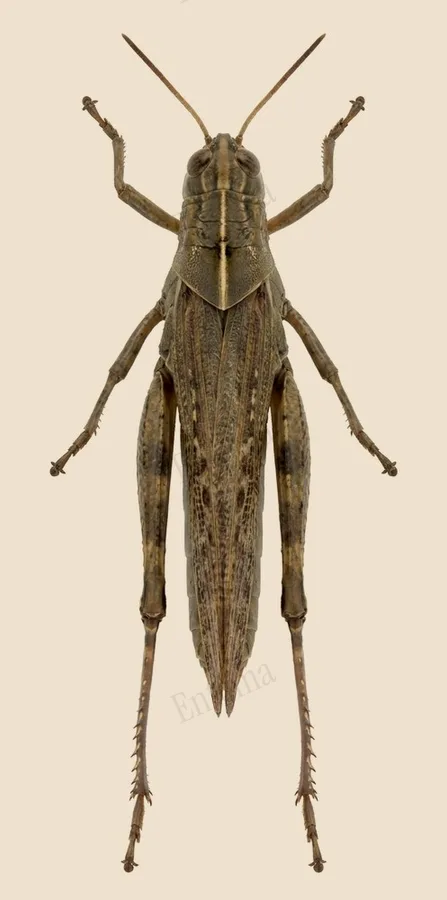
Egyptian bird grasshopper
Its eyes are marked with vertical black and white stripes, a pattern rare among grasshoppers, and this insect ranks among the largest grasshoppers found in Europe.
| Where | Warm scrubland, orchards and bushy habitat |
|---|---|
| Size | 35 to 81 mm body length |
| When | February to October |
Adults are large grey brown or olive grasshoppers with eyes crossed by vertical black and white bars, a pattern shared by no other common European grasshopper. Bright orange hind femora contrast with blue hind tibiae, and both sexes carry wings that extend well past the tip of the abdomen.
Eggs are laid just below the soil surface in spring, and the nymphs pass through several molts before reaching full size later in the year. Adults feed on a wide range of leaves and shelter among branches and foliage during the day.
Traits
Habitat
Farmland
Colour
Brown, Orange, Blue
Active
Day
To people
Feeds only on plant leaves and does not bite or sting; even in gardens it causes little lasting damage.
Activity through the year
Often confused with
Similar in length at about 40 to 65 mm, but lacks the black and white striped eyes and blue hind tibiae that mark the Egyptian bird grasshopper.
Questions
Is the Egyptian bird grasshopper dangerous to people?
Feeds only on plant leaves and does not bite or sting; even in gardens it causes little lasting damage.
When can you see the Egyptian bird grasshopper?
The Egyptian bird grasshopper can be seen from February to October, by day.
Plate retouched from a museum specimen photo by Simon Poulain, MNHN - Museum national d'Histoire naturelle, CC BY 4.0, GBIF Licence
Report a mistake in this entry
Crickets and grasshoppers›Grasshoppers›Anacridium
Last updated 2026-09-26. Every entry is checked against published sources.