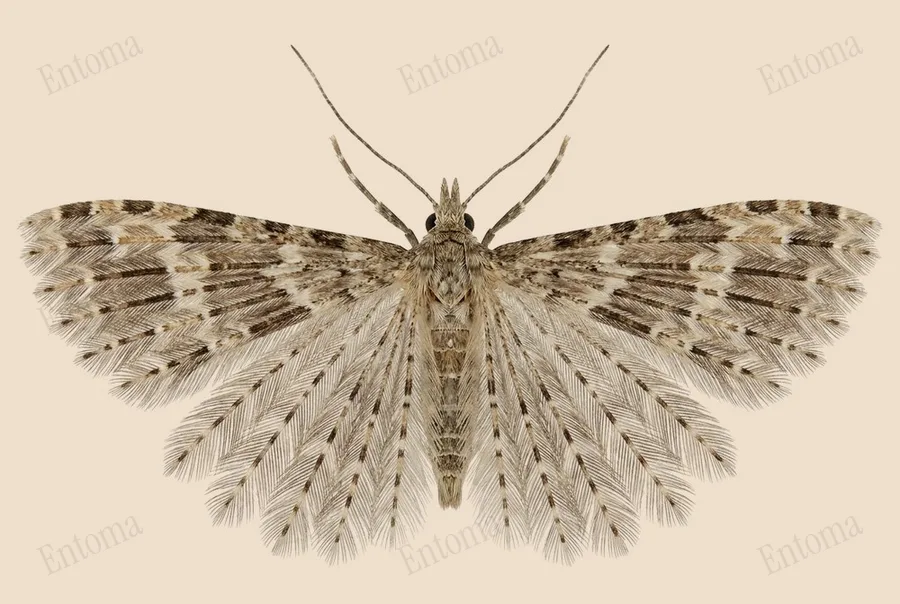
Twenty-plume moth
Despite its name, each wing is split into about twenty narrow feathered plumes rather than a single scaled surface.
| Where | Gardens and hedgerows near honeysuckle |
|---|---|
| Size | 14 to 16 mm wingspan |
| When | March to October |
The Twenty-plume Moth is tiny, with each forewing and hindwing divided into narrow, feather-like plumes fringed with fine scales, and a bold zigzag pattern of white, black and brown across the wings.
Caterpillars feed on the leaves and flower buds of honeysuckle. Adults can be found resting indoors at almost any time of year and are readily attracted to light.
Traits
Habitat
Garden
Colour
White, Black, Brown
Active
Night
To people
Often rests indoors on walls or curtains; harmless to people.
Activity through the year
Often confused with
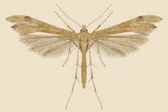
A true plume moth with a larger wingspan of about 18 to 27 mm and only two narrow, feather-edged lobes per wing, rather than the many fine plumes of the Twenty-plume Moth.
Questions
Is the Twenty-plume moth dangerous to people?
Often rests indoors on walls or curtains; harmless to people.
When can you see the Twenty-plume moth?
The Twenty-plume moth can be seen from March to October, at night.
Plate retouched from a photo by Donald Hobern from Copenhagen, Denmark, CC BY 2.0, Wikimedia Commons Licence
Report a mistake in this entry
Butterflies and moths›Many-plume moths›Alucita
Last updated 2026-09-26. Every entry is checked against published sources.