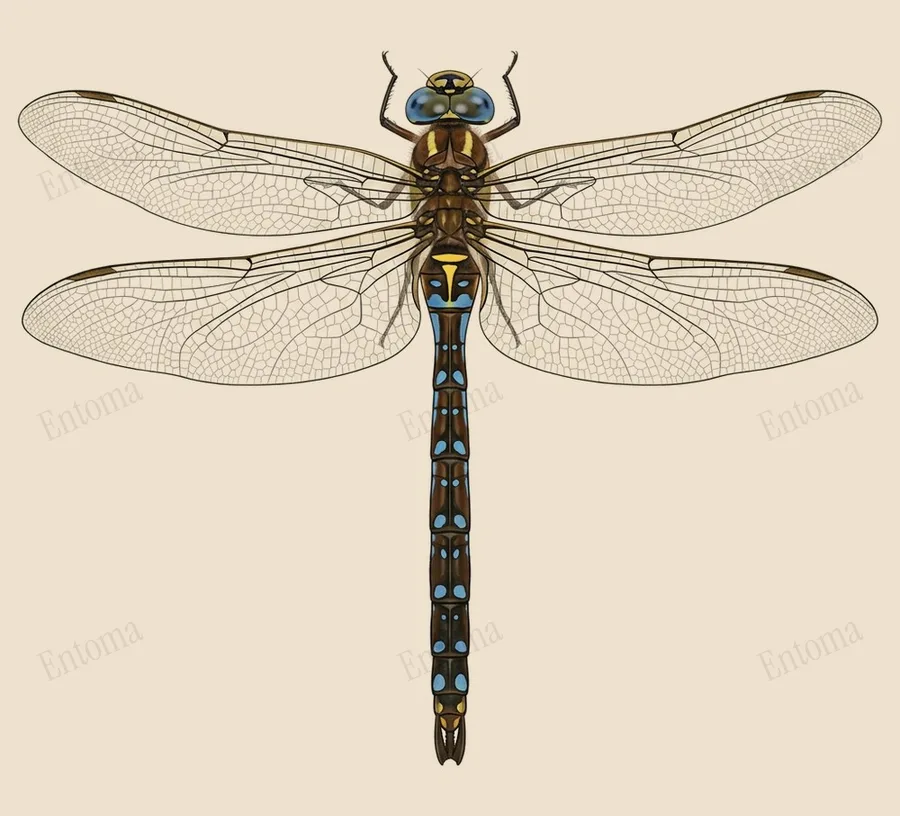
Migrant hawker
Although one of the smallest hawker dragonflies, migrant hawkers are not territorial and often hunt together in feeding swarms far from water.
| Where | Ponds, lakes and wetland edges |
|---|---|
| Size | 75 to 85 mm wingspan |
| When | July to November |
A small hawker with a yellow golf-tee shaped mark on the second abdominal segment; males combine a blackish abdomen with blue spots and blue eyes, while females are brown with yellow spots.
Eggs are laid in plant stems near water and pass the winter dormant, hatching in spring so the nymphs can grow quickly and adults emerge in mid to late summer.
Traits
Habitat
Wetland
Colour
Blue, Brown, Yellow
Active
Day
To people
Harmless; it feeds only on insects caught in flight.
Activity through the year
Often confused with
Noticeably larger, with a wingspan up to about 106 mm, and broad green antehumeral stripes on the thorax rather than the migrant hawker's short yellow ones.
Questions
Is the Migrant hawker dangerous to people?
Harmless; it feeds only on insects caught in flight.
When can you see the Migrant hawker?
The Migrant hawker can be seen from July to November, by day.
Plate retouched from a photo by Andreas Eichler, CC BY‑SA 4.0, Wikimedia Commons Licence
The plate on this page is shared under the same licence as its source, CC BY-SA.
Report a mistake in this entry
Dragonflies and damselflies›Hawkers›Aeshna
Last updated 2026-09-26. Every entry is checked against published sources.