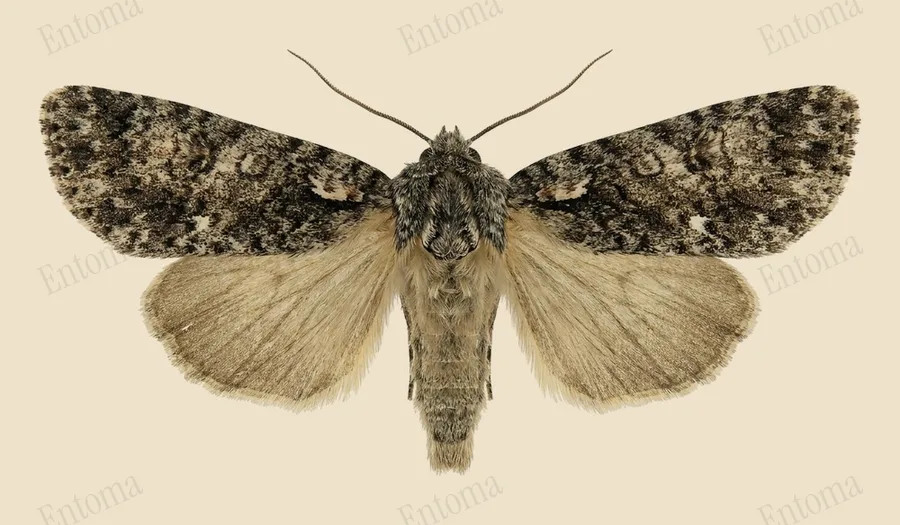
Knot grass moth
In this highly variable species, a single white spot placed halfway along the trailing edge of the forewing is often the only reliable clue to its identity.
| Where | Grassland, gardens and waste ground |
|---|---|
| Size | 30 to 38 mm wingspan |
| When | April to October |
The forewings are a mottled mix of dark and light grey, the hindwings dark brown, and a distinct white spot sits midway along the forewing's trailing edge; wingspan is roughly 30 to 38 mm.
Caterpillars are boldly marked and feed on a wide range of low plants and shrubs, with two generations on the wing across the warmer parts of its range.
Traits
Habitat
Grassland
Colour
Grey, Brown
Active
Night
To people
Harmless
Activity through the year
Often confused with
The grey dagger shows a narrow, black dagger-shaped streak near the base of the forewing, a mark the knot grass moth lacks.
Questions
Is the Knot grass moth dangerous to people?
The Knot grass moth is harmless to people.
When can you see the Knot grass moth?
The Knot grass moth can be seen from April to October, at night.
Plate retouched from a photo by Vítězslav Maňák (SLU), CC BY‑SA 4.0, Wikimedia Commons Licence
The plate on this page is shared under the same licence as its source, CC BY-SA.
Report a mistake in this entry
Butterflies and moths›Owlet moths›Acronicta
Last updated 2026-09-26. Every entry is checked against published sources.