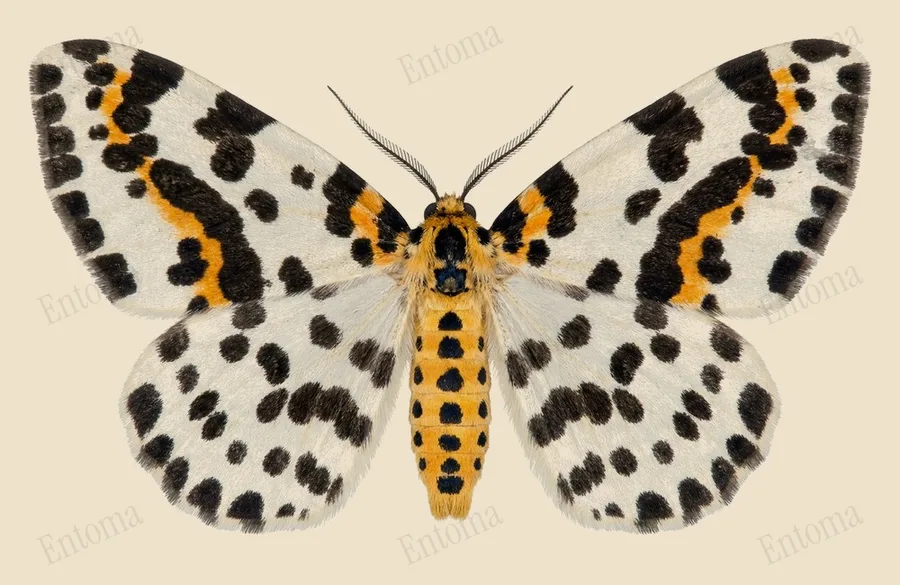
Magpie moth
Both the caterpillar and adult magpie moth carry a bitter chemical called sarmentosin, and birds that peck one usually drop it and avoid similarly patterned insects afterward.
| Where | Gardens, hedgerows and woodland edges |
|---|---|
| Size | 35 to 48 mm wingspan |
| When | June to August |
The Magpie Moth is boldly patterned in white, black and yellow, a striking combination shared by its yellow, black spotted caterpillar. The bold colours act as a warning rather than camouflage.
A single generation flies from June to August, and caterpillars feed through summer and autumn on shrubs such as gooseberry, currant, blackthorn and hawthorn before overwintering. The bright pattern warns predators that the moth is distasteful, and birds that try one tend to avoid the species afterward.
Traits
Habitat
Garden
Colour
White, Black, Yellow
Active
Night
To people
Not harmful to touch; its bitter body chemicals mainly deter predators such as birds rather than people.
Activity through the year
Often confused with
Similar bold white and black pattern, but the clouded magpie also carries orange and yellow patches in two groups rather than a single band, with a larger white area and grey-clouded rather than sharply banded black marks; its caterpillar feeds on elm and wych elm rather than currant bushes.
Questions
Is the Magpie moth dangerous to people?
Not harmful to touch; its bitter body chemicals mainly deter predators such as birds rather than people.
When can you see the Magpie moth?
The Magpie moth can be seen from June to August, at night.
Plate retouched from a photo by Janet Graham, CC BY 2.0, Wikimedia Commons Licence
Report a mistake in this entry
Butterflies and moths›Geometer moths›Abraxas
Last updated 2026-09-26. Every entry is checked against published sources.