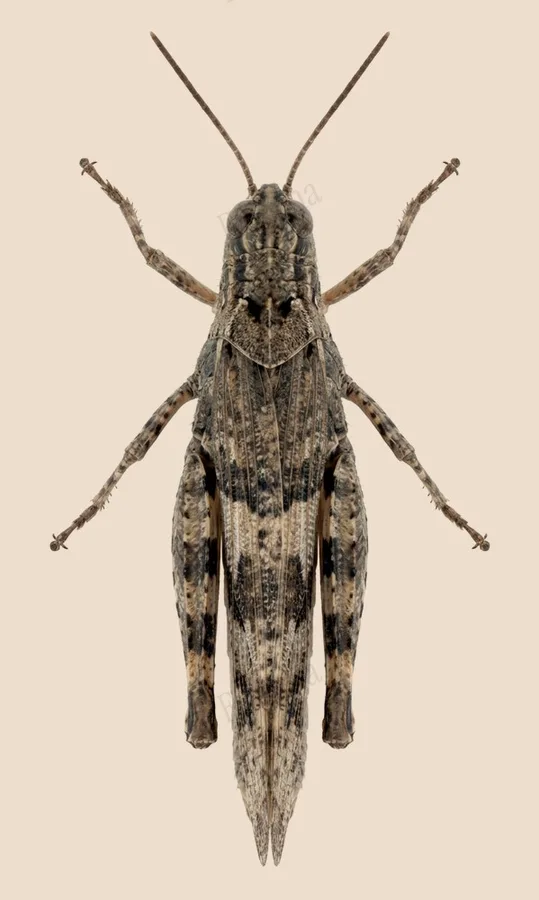
Pallid-winged grasshopper
This grasshopper is the most widely distributed banded-wing grasshopper in the Americas, ranging from western Canada all the way south to Argentina.
| Where | Deserts, dry fields, bare ground |
|---|---|
| Size | 25 to 45 mm body length |
| When | March to November |
The Pallid-winged grasshopper is tan to gray with two dark bands crossing each forewing and brown spots near the tips. The hindwing disk is pale yellow to whitish crossed by a narrow black band, and the hind femur is black with two yellow bars. Body length runs from about 25 to 45 mm.
It feeds on a wide range of grasses and forbs, including cheatgrass, crested wheatgrass and sagebrush, and adults bask on bare ground in dry, sparsely vegetated habitat. Strong fliers, they gather in large numbers around city lights at night as well as being active by day.
Traits
Habitat
Grassland
Colour
Brown, Grey, Yellow
Active
Day and night
To people
Harmless to people; large night gatherings around lights are its most noticeable behavior.
Activity through the year
Often confused with
Flashes blue to blue-green hindwings in flight instead of the pale yellow hindwings crossed by a narrow black band seen in the Pallid-winged grasshopper.
Questions
Is the Pallid-winged grasshopper dangerous to people?
Harmless to people; large night gatherings around lights are its most noticeable behavior.
When can you see the Pallid-winged grasshopper?
The Pallid-winged grasshopper can be seen from March to November, by day and at night.
Plate retouched from a photo by Robin Morehouse, CC BY 4.0, iNaturalist Licence
Report a mistake in this entry
Crickets and grasshoppers›Grasshoppers›Trimerotropis
Last updated 2026-09-27. Every entry is checked against published sources.