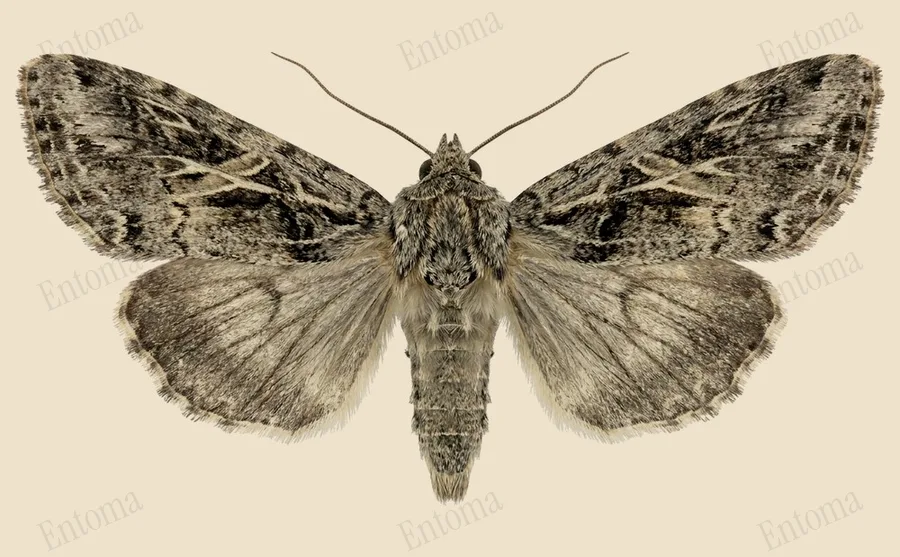
Yellow-striped armyworm moth
Young caterpillars of this moth feed in tight groups and skeletonize leaves together before scattering to feed alone, and adults can migrate long distances on strong wings.
| Where | Crop fields, gardens and weedy areas |
|---|---|
| Size | 34 to 41 mm wingspan |
| When | March to October |
The Yellow-striped armyworm moth has brownish-gray forewings crossed by irregular pale bands and dark markings, while the hindwings are pale, almost opalescent white with a narrow brown border.
Its caterpillars are strong generalist feeders on crops such as corn, beans, cotton, tomato and soybean, and populations build through three or four generations before cold weather ends the season.
Traits
Habitat
Farmland
Colour
Brown, Grey, White
Active
Night
To people
Harmless to people; the caterpillars can damage garden and farm plants when numerous.
Activity through the year
Often confused with
The two moths are difficult to tell apart as adults, but yellow-striped armyworm caterpillars carry triangular dark spots along the back, a shape used to separate them from sweetpotato armyworm caterpillars where their ranges overlap.
Questions
Is the Yellow-striped armyworm moth dangerous to people?
Harmless to people; the caterpillars can damage garden and farm plants when numerous.
When can you see the Yellow-striped armyworm moth?
The Yellow-striped armyworm moth can be seen from March to October, at night.
Plate retouched from a photo by John Rosford, CC BY 4.0, iNaturalist Licence
Report a mistake in this entry
Butterflies and moths›Owlet moths›Spodoptera
Last updated 2026-09-27. Every entry is checked against published sources.