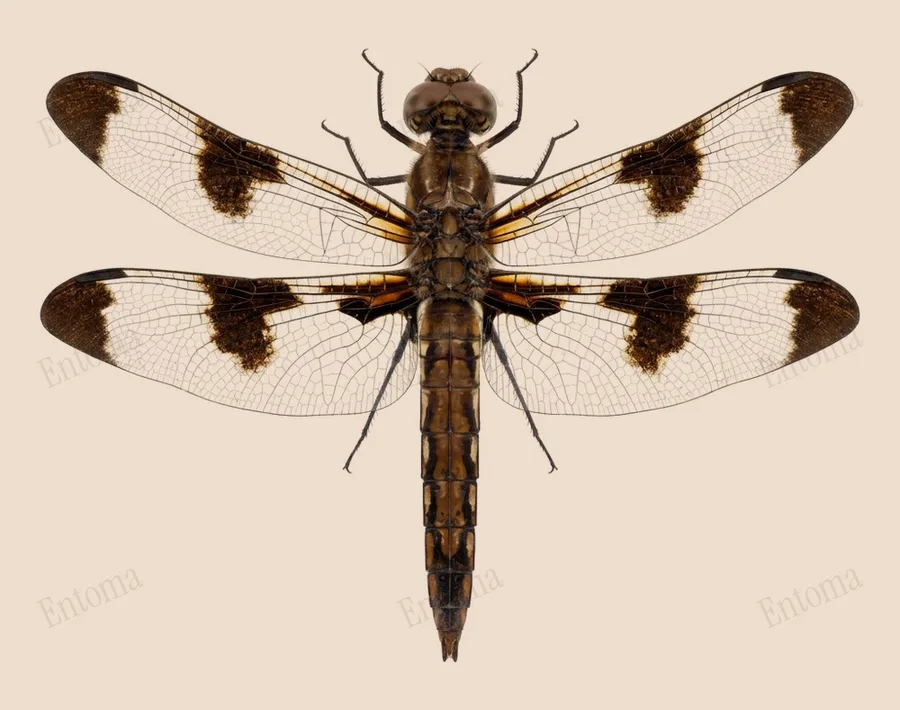
Common whitetail
Male Common Whitetails coat their abdomen in a chalky white wax as they mature, a pruinose layer that gives the species its name.
| Where | Ponds, lakes, marshes and slow streams |
|---|---|
| Size | 60 to 75 mm wingspan |
| When | April to September |
Mature males have a thick, chalky white abdomen and broad blackish-brown patches across each wing, while females are mottled brown with a zigzag pattern of pale spots along the abdomen and three dark patches on each wing. Wingspan runs from about 60 to 75 millimeters.
Males patrol short stretches of shoreline at ponds and slow streams, chasing off rivals and returning to the same favored perch, a behavior that makes them one of the most commonly noticed dragonflies in North America.
Traits
Habitat
Wetland
Colour
White, Black, Brown
Active
Day
To people
Common and conspicuous at garden ponds; does not sting or bite people.
Activity through the year
Often confused with
Each wing carries three brown patches, and males add white spots between them, unlike the plain dark wing bands of the Common Whitetail.
Questions
Is the Common whitetail dangerous to people?
Common and conspicuous at garden ponds; does not sting or bite people.
When can you see the Common whitetail?
The Common whitetail can be seen from April to September, by day.
Plate retouched from a photo by mmp133, CC BY 4.0, iNaturalist Licence
Report a mistake in this entry
Dragonflies and damselflies›Skimmers›Plathemis
Last updated 2026-09-26. Every entry is checked against published sources.