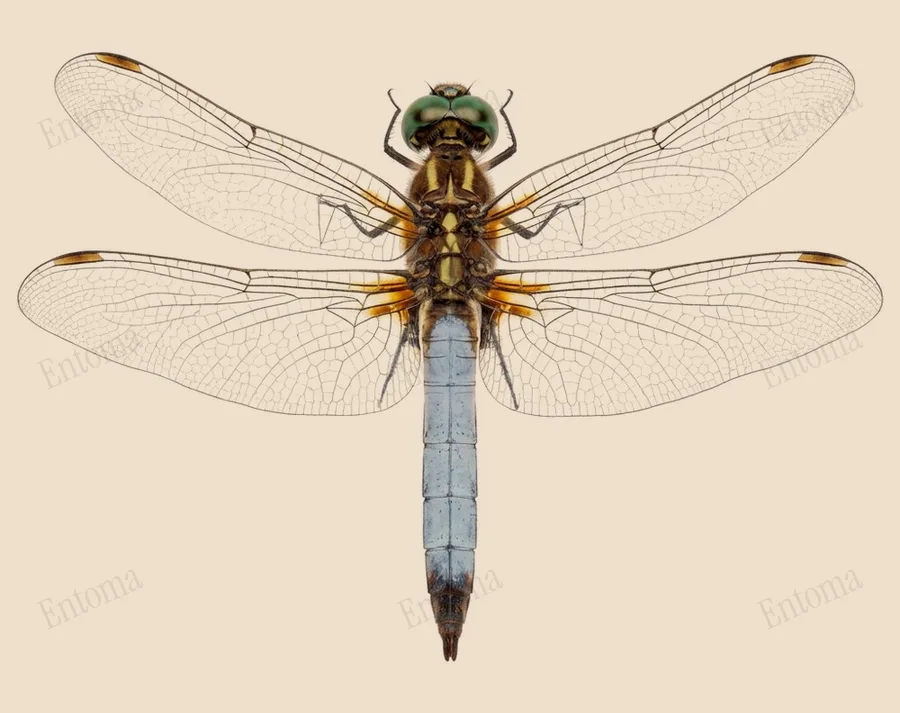
Blue dasher
Male Blue Dashers are green and black as young adults and turn pale sky blue as they age, coated in a waxy layer called pruinescence.
| Where | Ponds, lake edges and marshes |
|---|---|
| Size | 50 to 80 mm wingspan |
| When | April to September |
Mature males show a chalky blue abdomen, a black thorax with pale green stripes, and a plain white face; females and young males are patterned in green and black with rows of pale dashes along the abdomen. Body length runs from about 28 to 45 millimeters, with a wingspan of roughly 50 to 80 millimeters.
Adults perch low over still or slow water on twigs and reeds, darting out to catch small flying insects before returning to the same spot, a habit that makes them easy to watch at garden ponds and marshes.
Traits
Habitat
Wetland
Colour
Blue, Green, Black
Active
Day
To people
Common and easy to observe at garden ponds; does not sting or bite people.
Activity through the year
Often confused with
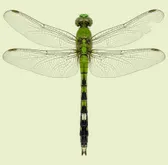
Lacks the Blue Dasher's plain white face and green-striped thorax, and mature males show a more uniform powder-blue body.
Questions
Is the Blue dasher dangerous to people?
Common and easy to observe at garden ponds; does not sting or bite people.
When can you see the Blue dasher?
The Blue dasher can be seen from April to September, by day.
Plate retouched from a museum specimen photo by Picturae, National Museum of Natural History, Smithsonian Institution, CC0, GBIF Licence
Report a mistake in this entry
Dragonflies and damselflies›Skimmers›Pachydiplax
Last updated 2026-09-26. Every entry is checked against published sources.