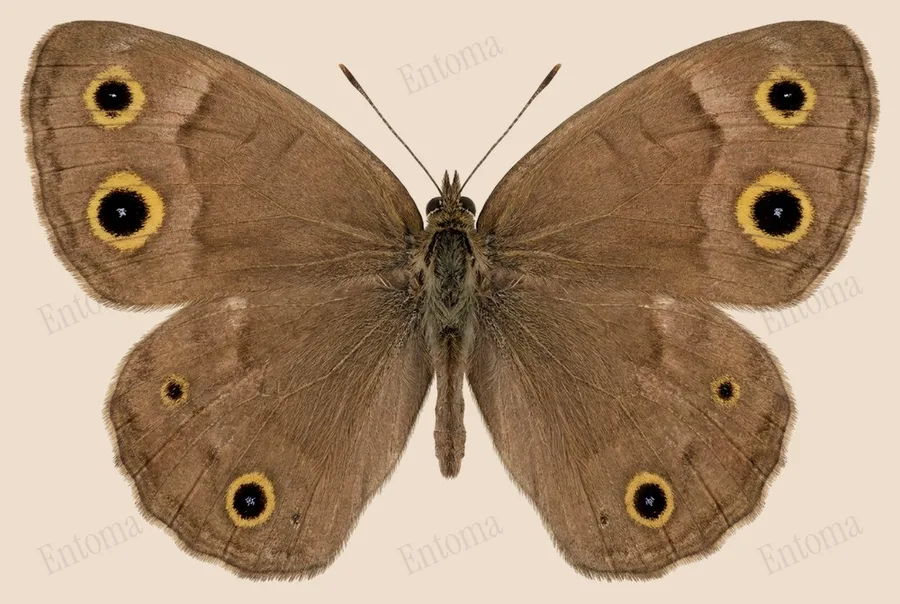
Little wood satyr
Large eyespots on all four wings may lure a bird's strike away from the body, and its low, bouncing flight makes the butterfly a difficult target to catch.
| Where | Eastern forests and woodland edges |
|---|---|
| Size | 29 to 48 mm wingspan |
| When | March to July |
Adults are grayish brown with large dark eyespots ringed in yellow on all four wings, two on each forewing upperside and a pair of bigger, doubled spots on the hindwing underside. The flight is low, bouncy and erratic, carrying the butterfly along woodland edges and grassy clearings rather than in a straight line.
Caterpillars are greenish brown with a dark stripe down the back and rows of small bumps that each carry a short hair; they feed at night on woodland grasses such as orchardgrass and Kentucky bluegrass, resting hidden by day.
Traits
Habitat
Woodland
Colour
Brown, Grey, Yellow
Active
Day
To people
Rests and feeds along woodland edges by day and poses no risk to people.
Activity through the year
Often confused with
The Carolina satyr lacks eyespots on the upperside of its forewings entirely, while the little wood satyr shows a spot on the upperside of every wing.
Questions
Is the Little wood satyr dangerous to people?
Rests and feeds along woodland edges by day and poses no risk to people.
When can you see the Little wood satyr?
The Little wood satyr can be seen from March to July, by day.
Plate retouched from a photo by Marshall Cleveland, CC BY 4.0, iNaturalist Licence
Report a mistake in this entry
Butterflies and moths›Brush-footed butterflies›Megisto
Last updated 2026-09-26. Every entry is checked against published sources.