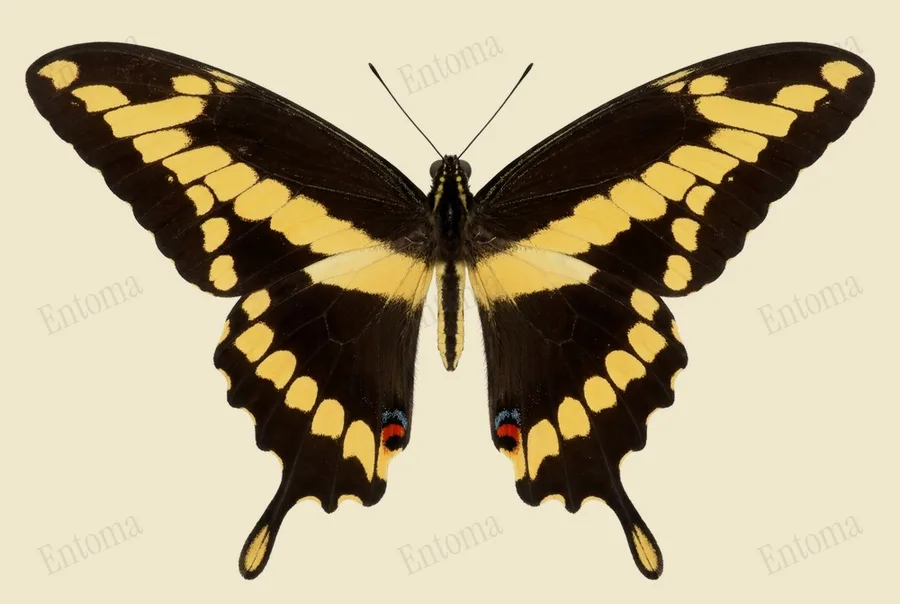
Eastern giant swallowtail
Young caterpillars mimic bird droppings, then release a foul, citrus scented smell from a forked orange gland behind the head when threatened.
| Where | Citrus groves, gardens and woodland edges |
|---|---|
| Size | 95 to 190 mm wingspan |
| When | March to October |
The Eastern giant swallowtail is one of the largest butterflies in North America, with blackish brown wings crossed by broad yellow bands that form an X near each forewing tip, and yellow centered tails on the hindwings.
Caterpillars feed on citrus, prickly ash, and hoptree, resembling bird droppings when young. If disturbed, they evert an orange forked organ called the osmeterium from behind the head, releasing a strong citrus smelling odor that deters ants and small predators.
Traits
Habitat
Garden
Colour
Black, Yellow, Blue
Active
Day
To people
Visits garden flowers and citrus blossoms for nectar and does not sting or bite people.
Activity through the year
Often confused with
Smaller, with a large rusty brown patch on the hindwing underside instead of the Eastern giant swallowtail's small red patch, and shorter, yellow edged tails.
Questions
Is the Eastern giant swallowtail dangerous to people?
Visits garden flowers and citrus blossoms for nectar and does not sting or bite people.
When can you see the Eastern giant swallowtail?
The Eastern giant swallowtail can be seen from March to October, by day.
Plate retouched from a photo by Larry Jensen, CC BY 4.0, iNaturalist Licence
Report a mistake in this entry
Butterflies and moths›Swallowtails›Heraclides
Last updated 2026-09-26. Every entry is checked against published sources.