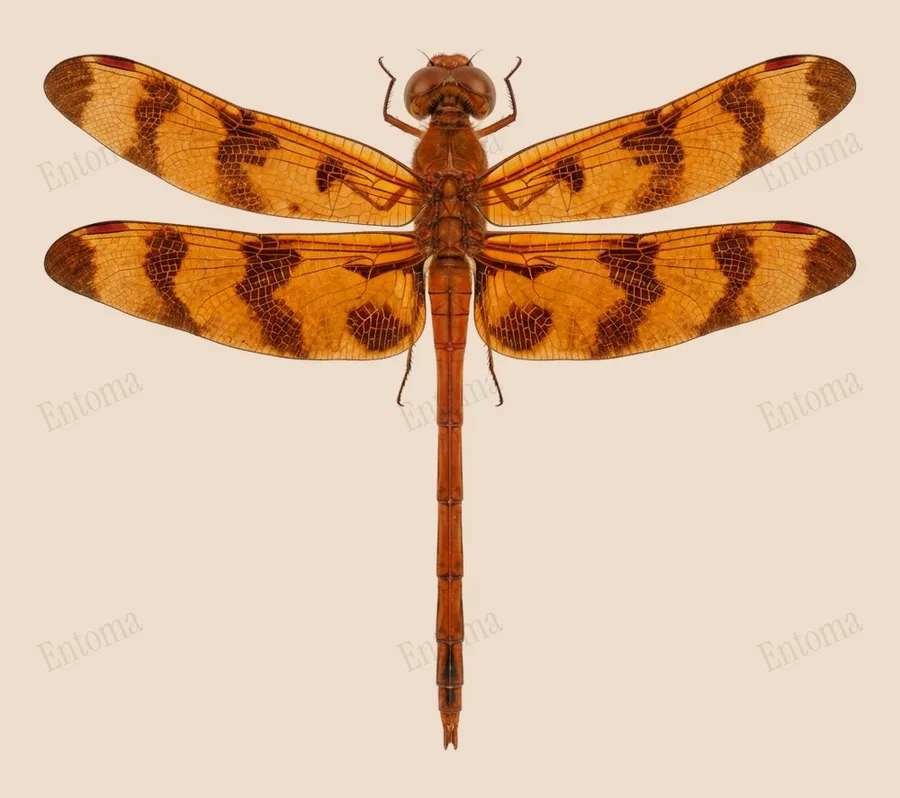
Halloween pennant
Halloween pennants keep flying in wind and rain that grounds most dragonflies, and pairs typically mate only during a narrow window in the morning.
| Where | Ponds, marshes and lake edges |
|---|---|
| Size | 36 to 43 mm body length |
| When | March to September |
The Halloween pennant is the largest species in its genus, with orange yellow wings crossed by dark brown bands and orange veins. Males develop reddish coloring in the face and wing veins as they mature, while females and young males keep paler yellow markings and a yellow stripe down the abdomen.
Adults perch on tall reeds and grass stems near ponds and marshes, flagging in the breeze like a pennant, and hunt small flying insects on the wing. Females lay eggs directly into the water while a male stays attached to guard her.
Traits
Habitat
Wetland
Colour
Orange, Black
Active
Day
To people
Often perches on grass stems near water; harmless to handle and does not bite.
Activity through the year
Often confused with
The Calico pennant has small dark spots confined near the leading edge of each wing that never form a full band, unlike the Halloween pennant's wide dark bands that cross the whole wing.
Questions
Is the Halloween pennant dangerous to people?
Often perches on grass stems near water; harmless to handle and does not bite.
When can you see the Halloween pennant?
The Halloween pennant can be seen from March to September, by day.
Plate retouched from a photo by Jimmy Dee, CC BY‑SA 4.0, iNaturalist Licence
The plate on this page is shared under the same licence as its source, CC BY-SA.
Report a mistake in this entry
Dragonflies and damselflies›Skimmers›Celithemis
Last updated 2026-09-26. Every entry is checked against published sources.