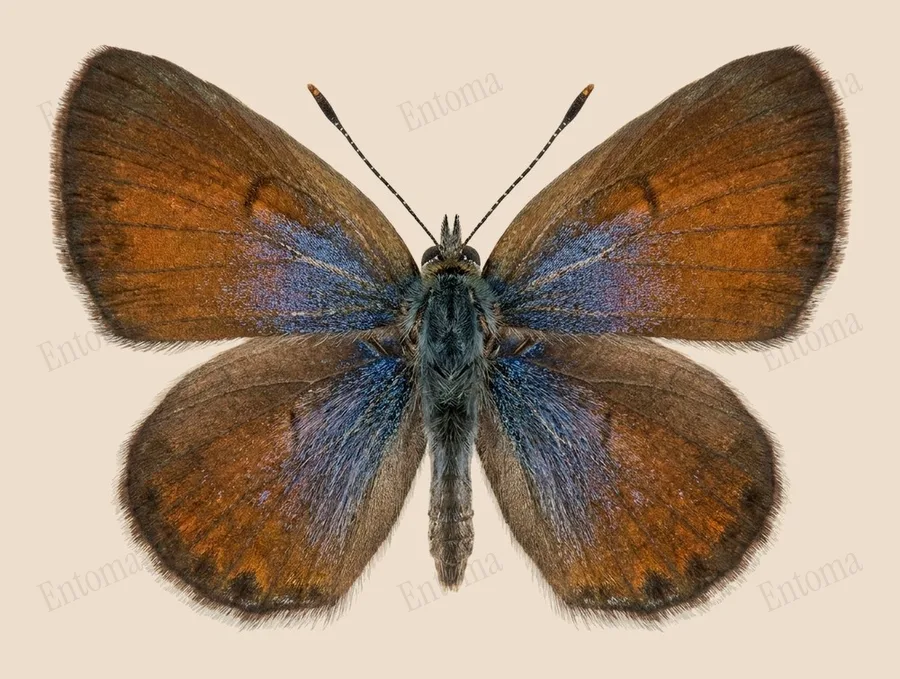
Western pygmy-blue
Barely wider than a fingernail, this butterfly ranks as the smallest in North America, yet hundreds can gather together over just a few square meters of habitat.
| Where | Salt marshes, deserts, alkaline flats |
|---|---|
| Size | 12 to 20 mm wingspan |
| When | March to December |
The Western pygmy-blue is a tiny butterfly with shimmery copper-brown wings tinged with dusky blue at the base above, while the hindwing below is copper-brown with a white patch at the base, a mostly white fringe, and small black spots near the outer margin. Its wingspan measures only about 12 to 20 mm.
Caterpillars feed on saltbush, goosefoot and related plants growing in alkaline soil, and adults fly low over these host plants in salt marshes, desert washes and other alkaline ground. In warmer parts of its range it can be seen flying nearly year round.
Traits
Habitat
Wetland
Colour
Brown, Blue, White
Active
Day
To people
Harmless to people; too small and low-flying for most people to notice.
Activity through the year
Often confused with

Considerably larger at about 22 to 29 mm wingspan, with wavy tan and white banding on the underside rather than the plain copper-brown and white pattern of the Western pygmy-blue.
Questions
Is the Western pygmy-blue dangerous to people?
Harmless to people; too small and low-flying for most people to notice.
When can you see the Western pygmy-blue?
The Western pygmy-blue can be seen from March to December, by day.
Plate retouched from a photo by Bill Levine, CC BY 4.0, iNaturalist Licence
Report a mistake in this entry
Butterflies and moths›Blues and coppers›Brephidium
Last updated 2026-09-27. Every entry is checked against published sources.