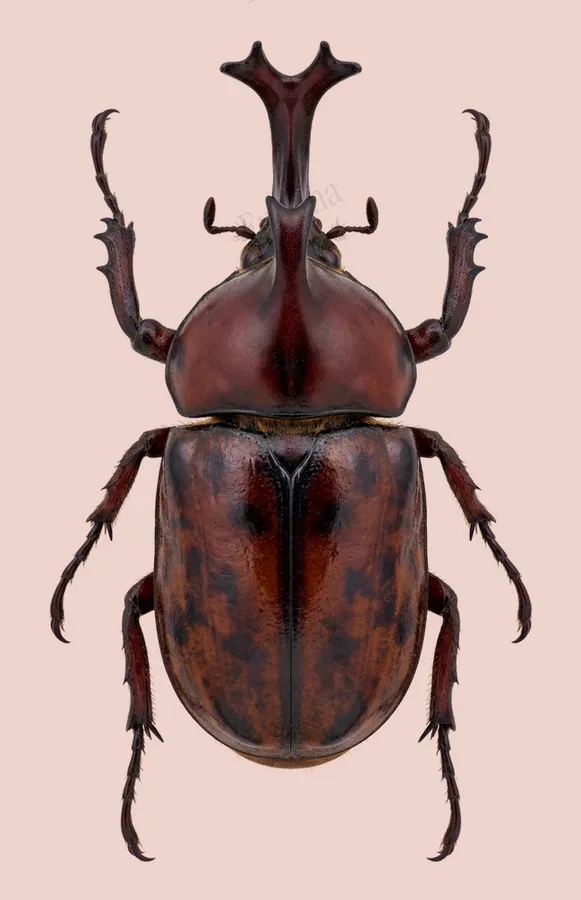
Japanese rhinoceros beetle
Males carry a forked head horn that can reach two thirds of the body's length, using it as a lever to flip rivals off sap-feeding sites on trees.
| Where | Oak forests across Japan and Korea |
|---|---|
| Size | 35 to 80 mm body length |
| When | June to September |
Males of the Japanese rhinoceros beetle are heavy bodied and glossy black to reddish brown, with a long, forked horn on the head and a smaller horn on the thorax; body length ranges from about 35 mm in small females to 80 mm or more in large males. Females lack horns entirely.
Adults emerge in early summer and are active at night, climbing oak and other broad-leaved trees to feed on sap and mate, while larvae take up to a year to develop in rich, decaying leaf litter and rotten wood.
Traits
Habitat
Woodland
Colour
Black, Red
Active
Night
To people
Harmless to people; the horn is used in contests between males, not as a weapon against humans.
Activity through the year
Often confused with
A much smaller relative from the same East Asian range, at only about 18 to 26 mm long, with a low horn-like bump instead of the long forked horn of the Japanese rhinoceros beetle.
Questions
Is the Japanese rhinoceros beetle dangerous to people?
Harmless to people; the horn is used in contests between males, not as a weapon against humans.
When can you see the Japanese rhinoceros beetle?
The Japanese rhinoceros beetle can be seen from June to September, at night.
Plate retouched from a museum specimen photo by National Museum of Natural History, Luxembourg, CC0, GBIF Licence
Report a mistake in this entry
Last updated 2026-09-27. Every entry is checked against published sources.