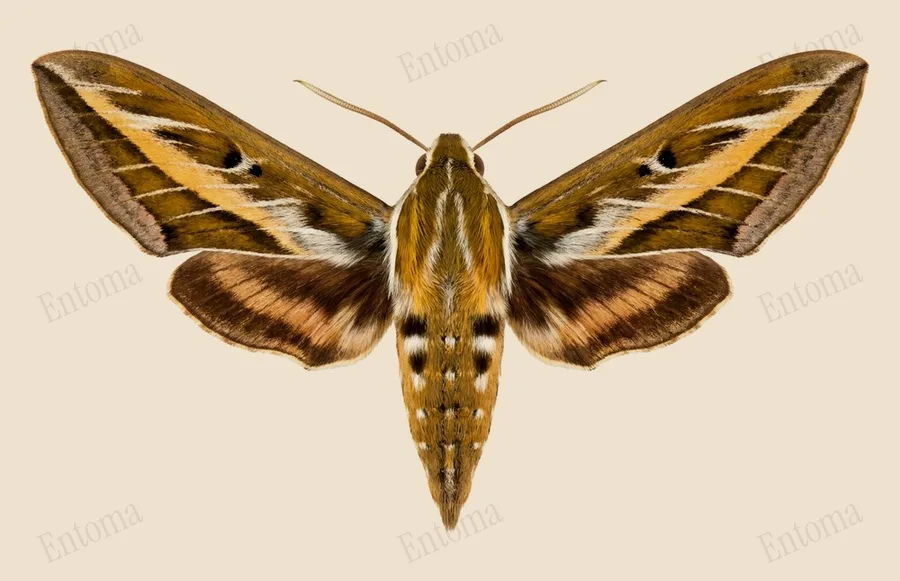
White-banded hunter hawkmoth
This hawkmoth's caterpillar can complete its entire growth in under a month when kept warm, one of the fastest developing hawkmoths known in captivity.
| Where | Gardens and disturbed ground across Asia |
|---|---|
| Size | 54 to 80 mm wingspan |
| When | May to October |
The White-banded hunter hawkmoth is greyish brown with a pair of pale, silvery white stripes running along the top of the abdomen and oblique, dark-edged stripes across each forewing; the wingspan spans roughly 54 to 80 mm. It is one of the most widespread hawkmoths in Asia and Australia, reaching from Afghanistan across to Japan and south to Australia.
Caterpillars feed on a wide range of plants, including grapevines, busy Lizzie and its relatives, and species of taro and evening primrose, and can grow from hatchling to full size in under a month in warm conditions.
Traits
Habitat
Garden
Colour
Brown, Grey
Active
Night
To people
Harmless to people; adults come to lights at night but do not bite or sting.
Activity through the year
Often confused with
Very similar in size, with an overlapping wingspan of about 55 to 80 mm, and sharing several of the same host plants such as grapevine; the two are best told apart by fine wing pattern detail rather than by size.
Questions
Is the White-banded hunter hawkmoth dangerous to people?
Harmless to people; adults come to lights at night but do not bite or sting.
When can you see the White-banded hunter hawkmoth?
The White-banded hunter hawkmoth can be seen from May to October, at night.
Plate retouched from a museum specimen photo by Taiwan Biodiversity Research Institute, CC BY 4.0, GBIF Licence
Report a mistake in this entry
Butterflies and moths›Hawk moths›Theretra
Last updated 2026-09-27. Every entry is checked against published sources.