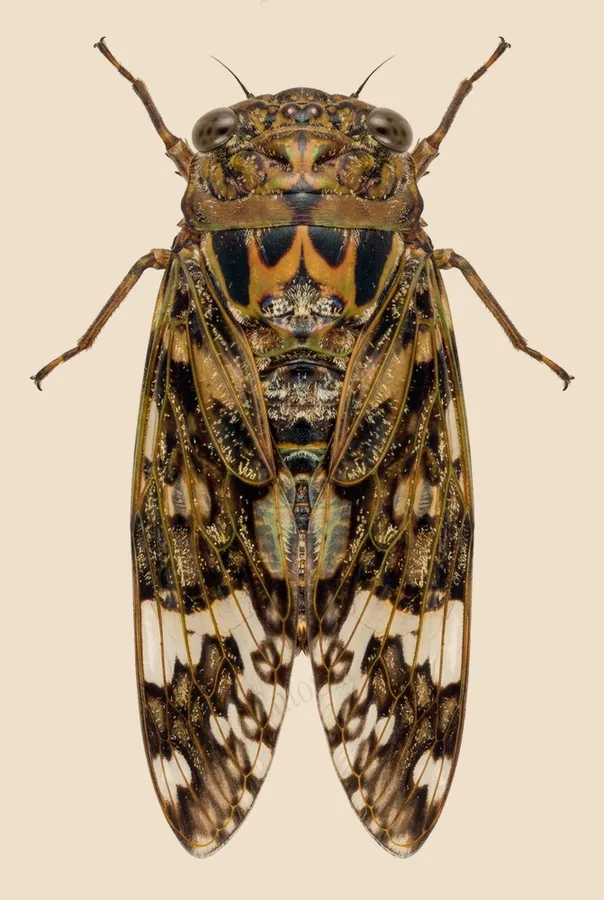
Kaempfer cicada
This cicada blends so well with tree bark that one population turned up far outside its native range, in Poland, after hitching a ride with imported plants.
| Where | Low-altitude woodland across East Asia |
|---|---|
| Size | 35 to 38 mm body length |
| When | June to August |
The Kaempfer cicada has a stout, mottled body patterned in shades of yellow-green, brown and black that closely matches tree bark, making it hard to spot at rest on a trunk. Adults measure about 35 to 38 mm long, with dark-marked, partly clouded forewings typical of the genus.
Nymphs live underground feeding on root sap before climbing tree trunks to complete their final molt, and calling males are most active from morning through the afternoon in low-altitude woodland and parks across Japan, Korea, China and Taiwan.
Traits
Habitat
Woodland
Colour
Green, Brown, Black
Active
Day
To people
Harmless to people; it feeds only on tree sap through its beak-like mouthparts and cannot bite or sting.
Activity through the year
Often confused with
Similar in size, but the Evening cicada has plain reddish-brown, clear wings and calls mainly at dawn and dusk, while the Kaempfer cicada has mottled, part-clouded wings and calls through the day.
Questions
Is the Kaempfer cicada dangerous to people?
Harmless to people; it feeds only on tree sap through its beak-like mouthparts and cannot bite or sting.
When can you see the Kaempfer cicada?
The Kaempfer cicada can be seen from June to August, by day.
Plate retouched from a photo by りなべる, CC BY 4.0, iNaturalist Licence
Report a mistake in this entry
Last updated 2026-09-27. Every entry is checked against published sources.