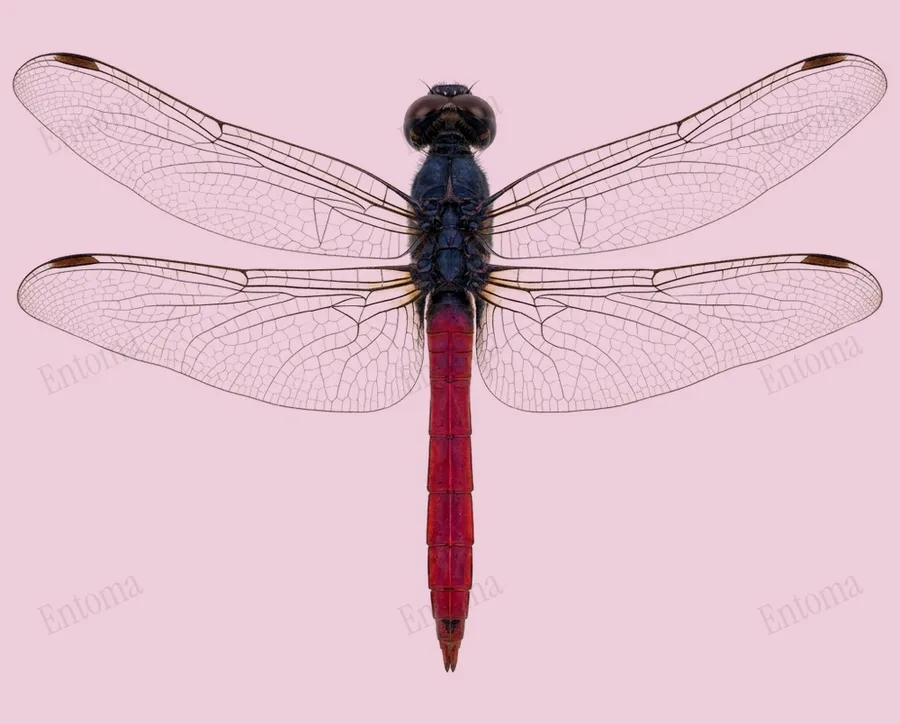
Crimson-tailed marsh hawk
Mature males owe their vivid violet red color not to pigment but to a fine waxy bloom called pruinescence that develops as they age.
| Where | Ponds and streams across southern Asia |
|---|---|
| Size | 28 to 31 mm abdomen length |
| When | April to November |
Mature males are violet red across the thorax and abdomen thanks to a powdery pruinescence, with a blackish thorax showing a faint purple sheen; young males start out plain red before this bloom develops. Females are duller and less strikingly colored than males.
It breeds in ponds, lakes and slow moving streams, including paddy fields, across a wide range from India to Japan and south to the Sunda Islands, and recent genetic studies suggest this range may actually contain more than one true species.
Traits
Habitat
Wetland
Colour
Red, Black, Blue
Active
Day
To people
Not aggressive towards people; safe to watch perched near ponds.
Activity through the year
Often confused with
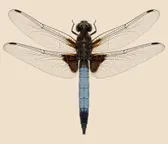
Abdomen mostly azure blue with only the first two and last three segments black, rather than the violet red abdomen seen in this species.
Questions
Is the Crimson-tailed marsh hawk dangerous to people?
Not aggressive towards people; safe to watch perched near ponds.
When can you see the Crimson-tailed marsh hawk?
The Crimson-tailed marsh hawk can be seen from April to November, by day.
Plate retouched from a photo by Jerome Ko, CC BY 4.0, iNaturalist Licence
Report a mistake in this entry
Dragonflies and damselflies›Skimmers›Orthetrum
Last updated 2026-09-27. Every entry is checked against published sources.