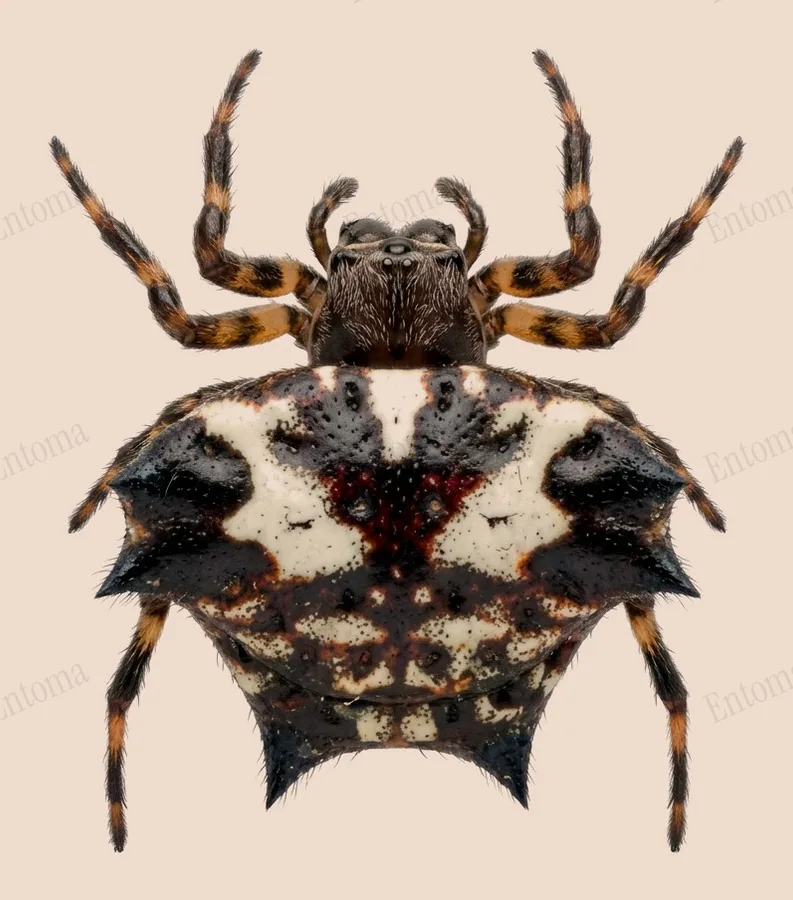
Black-and-white spiny spider
Female black-and-white spiny spiders carry six black spines on a flattened abdomen, while males have no spines and grow to less than half the female's width.
| Where | Forest edges and mountain scrub |
|---|---|
| Size | Female 6 to 10 mm, male 3 to 4 mm body length |
| When | January to December |
The black-and-white spiny spider has a hard, flattened abdomen edged with six stiff black spines and patterned with variable black and white or grey patches, often forming a Y shaped mark down the middle. Males are smaller and plainer, with small bumps in place of spines.
It builds a vertical circular web between branches at forest edges and low mountain scrub, sitting head down at the centre of the web to wait for passing insects. Females lay their eggs in golden or brown sacs fixed to tree trunks.
Traits
Habitat
Woodland
Colour
Black, White
Active
Day and night
To people
This spider is not known to bite people; its spines are a defence against birds and other predators, not a threat to humans.
Activity through the year
Often confused with
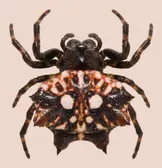
Similar spiny, shell-like abdomen, but its spines are shorter and its pattern usually shows two large white spots rather than the Y shaped black mark of the black-and-white spiny spider.
Questions
Is the Black-and-white spiny spider dangerous to people?
This spider is not known to bite people; its spines are a defence against birds and other predators, not a threat to humans.
When can you see the Black-and-white spiny spider?
The Black-and-white spiny spider can be seen from January to December, by day and at night.
Plate retouched from a photo by Devin, CC BY 4.0, iNaturalist Licence
Report a mistake in this entry
Spiders›Orb-weaver spiders›Gasteracantha
Last updated 2026-09-27. Every entry is checked against published sources.