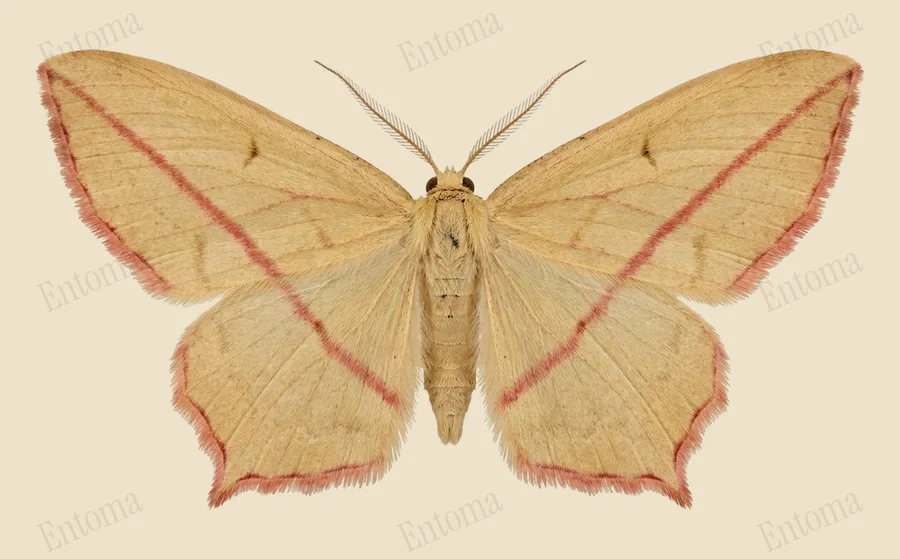
Blood-vein
This moth's pale wings are crossed by a thin reddish line said to resemble a vein, and it can produce three overlapping generations in warm southern regions.
| Where | Damp grassland, hedgerows and gardens |
|---|---|
| Size | 24 to 28 mm wingspan |
| When | May to September |
The Blood-vein has pale straw yellow wings crossed by a thin, reddish-pink line that runs diagonally across both fore and hindwings, giving the species its name. A fine dark dot sits near the center of each wing, and the wing margins are edged with a faint reddish fringe.
Two generations fly each year, one in late spring and a second in late summer, with a possible third generation overlapping the first two in warmer southern areas. Caterpillars feed on low plants such as dock and knotgrass in damp grassy places.
Traits
Habitat
Wetland
Colour
Yellow, Red
Active
Night
To people
Attracted to light; harmless to people.
Activity through the year
Often confused with
Similar in size at about 26 to 29 mm wingspan, but paler and more uniformly cream colored, without the sharp reddish diagonal line of the Blood-vein.
Questions
Is the Blood-vein dangerous to people?
Attracted to light; harmless to people.
When can you see the Blood-vein?
The Blood-vein can be seen from May to September, at night.
Plate retouched from a photo by Patrick Clement from West Midlands, England, CC BY 2.0, Wikimedia Commons Licence
Report a mistake in this entry
Butterflies and moths›Geometer moths›Timandra
Last updated 2026-09-26. Every entry is checked against published sources.