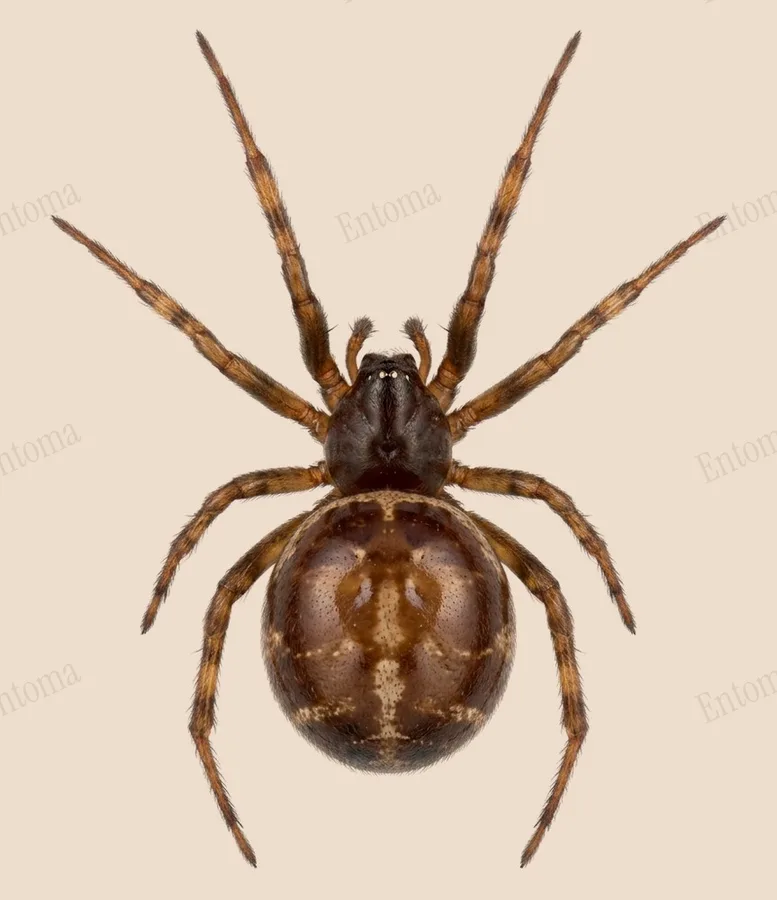
Rabbit hutch spider
Its bulbous brown abdomen and dark dimple markings make it resemble a false widow spider, though no bite from this species has ever been documented.
| Where | Buildings, sheds and outbuildings across Europe |
|---|---|
| Size | Female 4.5 to 7 mm, male 4 to 5 mm body length |
| When | January to December |
The Rabbit hutch spider has a shiny, bulbous brown abdomen with a broken pale line down the centre and another pale band near the front, plus a pair of small dark dimples that give the species its scientific name. It is often mistaken for the more medically notable false widow spiders it resembles.
It builds a tangled cobweb in sheds, outbuildings and other structures, hiding in a crevice by day and coming out at night to wait upside down in the web for insects that touch its sticky lines.
Traits
Habitat
Towns
Colour
Brown, White
Active
Night
To people
Resembles the false widow spiders it is often named alongside, but no bite has been documented and its small fangs are thought unlikely to break human skin, so it is not dangerous to people.
Activity through the year
Often confused with
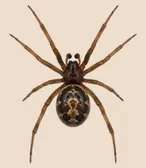
The Cupboard spider is more evenly dark purplish brown without pale markings, while the Rabbit hutch spider keeps a broken pale central line and a pale band near the front of the abdomen.
Questions
Is the Rabbit hutch spider dangerous to people?
Resembles the false widow spiders it is often named alongside, but no bite has been documented and its small fangs are thought unlikely to break human skin, so it is not dangerous to people.
When can you see the Rabbit hutch spider?
The Rabbit hutch spider can be seen from January to December, at night.
Plate retouched from a photo by Sébastien Storck, CC BY 4.0, iNaturalist Licence
Report a mistake in this entry
Spiders›Cobweb spiders›Steatoda
Last updated 2026-09-27. Every entry is checked against published sources.