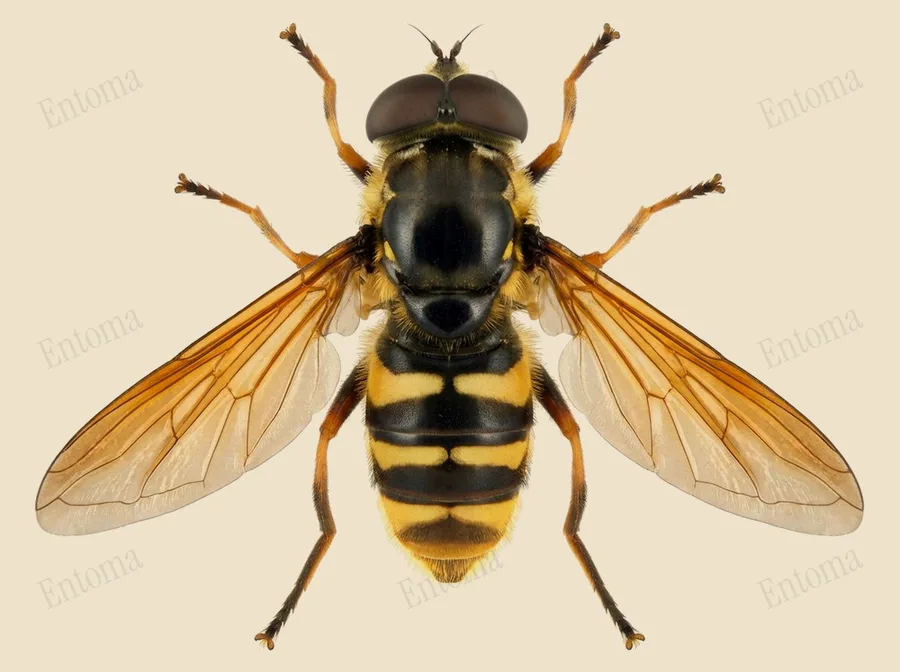
Yellow-barred peat hover fly
Although its black and yellow pattern mimics a wasp closely, its flight does not copy a wasp's flight style at all.
| Where | Bogs, mires and wet moorland |
|---|---|
| Size | 13 to 18 mm body length |
| When | May to October |
This large hoverfly has a wide, oval, black abdomen crossed by broad, wedge-shaped yellow bars, a dark scutellum fringed with bright yellow hairs, and yellowish legs with black at the base of the femora. It closely resembles a wasp in color and pattern, though it flies quite differently.
Rat-tailed larvae live in peaty pools, ditches and decaying wood in bogs and wet moorland, breathing through a long extendable tube, and the species produces two generations a year while adults visit brambles, thistles and other open flowers.
Traits
Habitat
Wetland
Colour
Black, Yellow
Active
Day
To people
Harmless wasp mimic; it has no sting and cannot bite, relying on its black and yellow pattern to deter predators.
Activity through the year
Often confused with
Very similar overall, but its yellow abdominal bands are narrower, whitish yellow and briefly interrupted in the middle, and it has a reddish rather than dark scutellum.
Questions
Is the Yellow-barred peat hover fly dangerous to people?
Harmless wasp mimic; it has no sting and cannot bite, relying on its black and yellow pattern to deter predators.
When can you see the Yellow-barred peat hover fly?
The Yellow-barred peat hover fly can be seen from May to October, by day.
Plate retouched from a photo by Tiia Monto, CC BY‑SA 3.0, Wikimedia Commons Licence
The plate on this page is shared under the same licence as its source, CC BY-SA.
Report a mistake in this entry
Last updated 2026-09-26. Every entry is checked against published sources.