Black clock
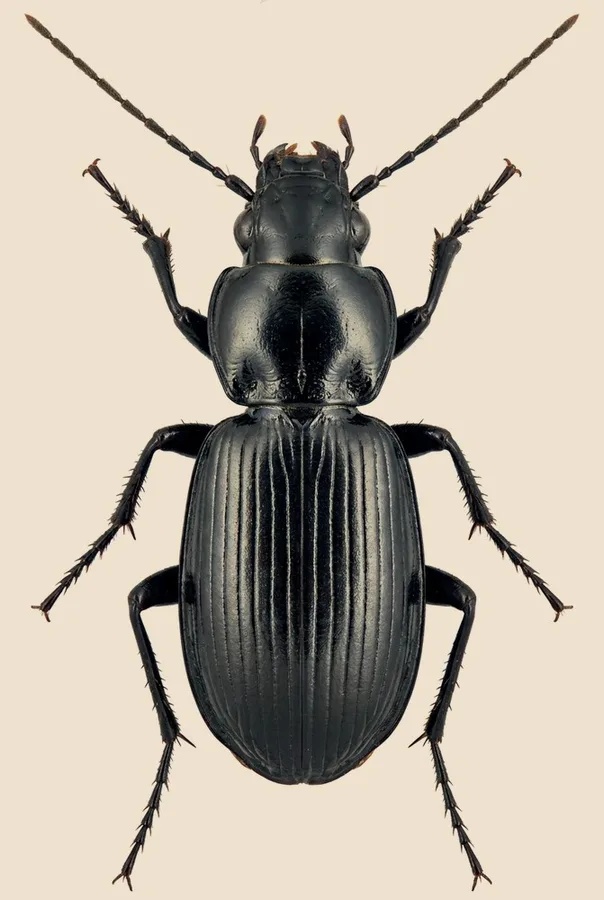
This common ground beetle has two colour forms, one with jet black legs and one with wine red thighs, and both occur widely across its range.
| Where | Gardens, farmland and dry woodland floor |
|---|---|
| Size | 13 to 20 mm body length |
| When | March to October |
This is a large, shiny black ground beetle with a smoothly rounded pronotum that helps separate it from similar species. One form has entirely black legs, while the other has distinctive wine red femora.
It shelters under stones, loose bark and grass tussocks in gardens, farmland and dry woodland, and is active by both day and night. It hunts caterpillars, slugs and other ground invertebrates but also eats some plant material.
Traits
Habitat
Garden
Colour
Black, Red
Active
Day and night
To people
Harmless to people; often found sheltering under stones and logs by day.
Activity through the year
Often confused with
Similar size or slightly larger, 15 to 21 mm, entirely black apart from red claws and leg spines, without the wine red femora form seen in the black clock.
Questions
Is the Black clock dangerous to people?
Harmless to people; often found sheltering under stones and logs by day.
When can you see the Black clock?
The Black clock can be seen from March to October, by day and at night.
Plate retouched from a photo by Francisco Welter-Schultes, CC0, Wikimedia Commons Licence
Report a mistake in this entry
Beetles›Ground beetles›Pterostichus
Last updated 2026-09-26. Every entry is checked against published sources.