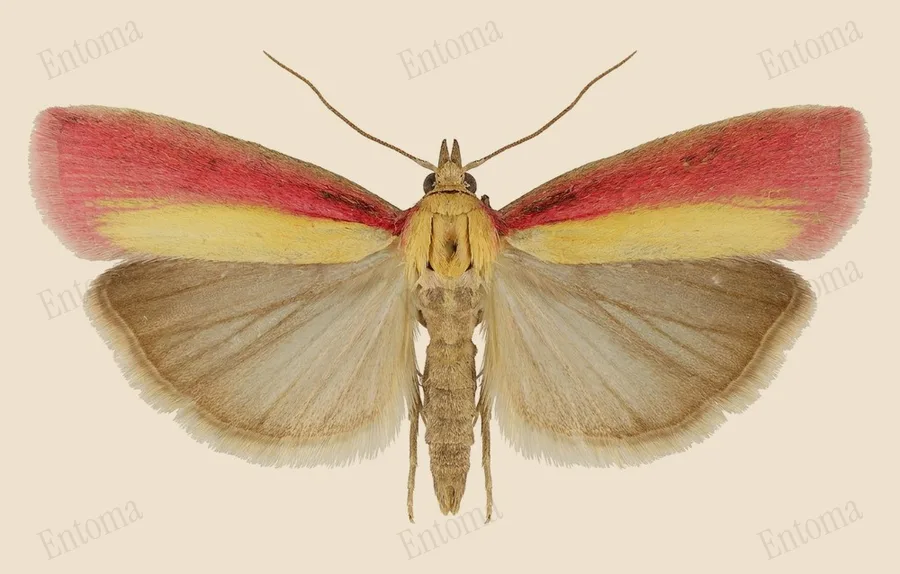
Rosy-striped knot-horn
Despite its base in chalk grassland, this pink and yellow moth's range also reaches Japan, China and South Korea.
| Where | Chalk downland and short grassland |
|---|---|
| Size | 17 to 29 mm wingspan |
| When | June to September |
The Rosy-striped Knot-horn is a small moth with bright pink and yellow forewings, sometimes crossed by a thin whitish streak along the leading edge, giving it a distinctive two toned look among grassland moths.
Adults rest low in short turf by day and fly at dusk, when they come readily to light. Caterpillars feed on clover and bird's foot trefoil, spinning tough silken tubes near the base of the plants.
Traits
Habitat
Grassland
Colour
Red, Yellow
Active
Night
To people
Rests low in open grassland by day and comes to light after dusk; harmless to people.
Activity through the year
Often confused with
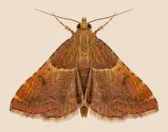
Similar warm coloring at about 18 to 23 mm wingspan, but more uniformly orange brown without the sharp pink and yellow two tone pattern, and it holds its wings in a triangular tent shape at rest.
Questions
Is the Rosy-striped knot-horn dangerous to people?
Rests low in open grassland by day and comes to light after dusk; harmless to people.
When can you see the Rosy-striped knot-horn?
The Rosy-striped knot-horn can be seen from June to September, at night.
Plate retouched from a photo by Pekka Malinen, Luomus, CC BY‑SA 4.0, Wikimedia Commons Licence
The plate on this page is shared under the same licence as its source, CC BY-SA.
Report a mistake in this entry
Butterflies and moths›Pyralid moths›Oncocera
Last updated 2026-09-26. Every entry is checked against published sources.