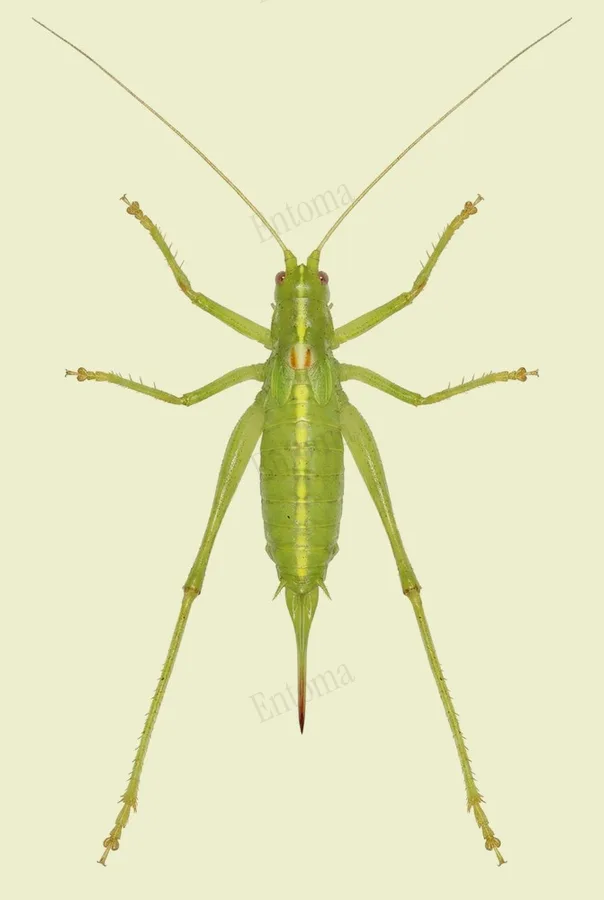
Southern oak bush-cricket
Both sexes carry only tiny flap-like wings and cannot fly at all, so this predator gets around entirely on foot through the tree canopy.
| Where | Oak woodland and broadleaved trees |
|---|---|
| Size | 14 to 17 mm long |
| When | July to November |
It is a slender pale green bush-cricket with a creamy stripe down the back, two small reddish marks on the thorax and very long thread-like antennae, reaching about 14 to 17 mm in body length. Males have long curved cerci while females carry an upturned ovipositor.
It hunts small invertebrates after dark in the canopy of oak and other broadleaved trees, including the horse-chestnut leaf miner, and its spread has followed the northward expansion of its range across parts of Europe.
Traits
Habitat
Woodland
Colour
Green
Active
Night
To people
Harmless
Activity through the year
Often confused with
The oak bush-cricket has full functional wings and can fly, while the southern oak bush-cricket's wings are reduced to tiny flaps and it stays flightless.
Questions
Is the Southern oak bush-cricket dangerous to people?
The Southern oak bush-cricket is harmless to people.
When can you see the Southern oak bush-cricket?
The Southern oak bush-cricket can be seen from July to November, at night.
Plate retouched from a photo by Zasil, CC BY‑SA 4.0, Wikimedia Commons Licence
The plate on this page is shared under the same licence as its source, CC BY-SA.
Report a mistake in this entry
Crickets and grasshoppers›Bush crickets›Meconema
Last updated 2026-09-26. Every entry is checked against published sources.