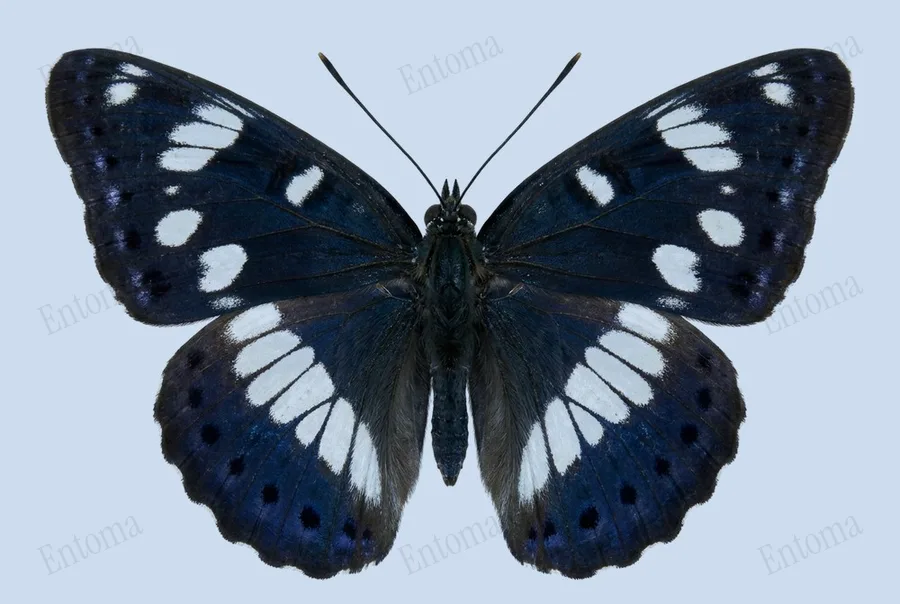
Southern white admiral
Its underside hindwing carries a single row of black spots, the one visible mark that separates it at a glance from its close relative the White admiral, which has two rows.
| Where | Woodland edges, glades and dry slopes |
|---|---|
| Size | 46 to 54 mm wingspan |
| When | May to September |
The Southern white admiral shows a dark brown to black upperside with a metallic blue sheen and a broad white transverse band, while the underside is reddish with a silvery base and a single row of black spots near the hindwing margin.
Caterpillars feed on honeysuckle, including Etruscan and other shrubby species, and the butterfly favours sunny woodland edges, glades and dry stony slopes, often gathering near streams and springs where its foodplant grows.
Traits
Habitat
Woodland
Colour
Black, Blue, White
Active
Day
To people
Visits flowers and damp ground; harmless to people.
Activity through the year
Often confused with
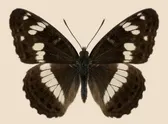
Very similar in size at about 56 to 66 mm wingspan, but told apart by a double row of black dots near the hindwing edge, compared with the single row of the Southern white admiral.
Questions
Is the Southern white admiral dangerous to people?
Visits flowers and damp ground; harmless to people.
When can you see the Southern white admiral?
The Southern white admiral can be seen from May to September, by day.
Plate retouched from a photo by Charles J. Sharp, CC BY‑SA 4.0, Wikimedia Commons Licence
The plate on this page is shared under the same licence as its source, CC BY-SA.
Report a mistake in this entry
Butterflies and moths›Brush-footed butterflies›Limenitis
Last updated 2026-09-26. Every entry is checked against published sources.